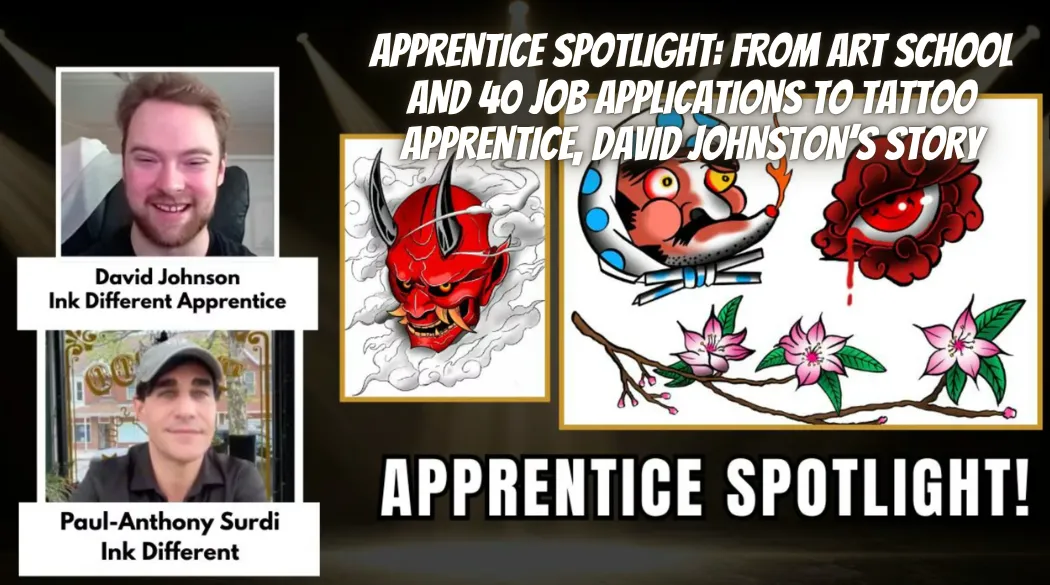
Apprentice Spotlight: From Art School and 40 Job Applications to Tattoo Apprentice, David Johnston’s Story
David Johnston spent about five years in college, switching from computer science to fine arts. He dreamed of making video games. Then the job market hit hard. In a single week, he sent out 30 to 40 job applications and kept hearing the same answers. That’s when his dad pulled him aside and asked, “Why don’t you just do tattoos?” Today, David is in Phase Two of Ink Different’s Traditional Tattoo Apprenticeship in Colorado, working through practice pads and getting ready for Phase Three. We sat down with David to hear how he made the switch.
Key Takeaways
The pivot: After art school and a frustrating job search, David took his dad’s advice and looked into tattooing.
The mindset: He reframed starting over as a chance to learn something new and enjoy the process.
Phase Two is a new skill: Depth and stability with a tattoo machine were harder than he expected, but he’s seeing steady progress.
Key lessons: Dab instead of wiping, plan where to start the tattoo, and think in lines instead of a finished image.
His advice: Compare yourself to yesterday’s you, and aim to be 1% better each day.
Who is David Johnston and why does his story matter?
David Johnston is an Ink Different tattoo apprentice in Colorado and a self-described huge Broncos fan.
He got his first tattoos at 16: kanji on each shoulder. He admits they’re terrible, and one is now covered by a sleeve. He still remembers walking into that tattoo shop for the first time and being surprised that it smelled good, mostly like Vaseline.
Drawing was how David passed the time in high school. He doesn’t think of it as natural talent. He believes anyone can learn to draw if they put in the time and effort. It just came easily to him.
His story matters because many artists with college training face the same question he did: what now? David’s answer was to bring his art skills into a craft he finds meaningful.

Why did art school leave David feeling stuck?
David started college as a computer science major because he wanted to make games for a living. Later, he switched to fine arts. As his dream evolved, the job market made it hard to find work.
He applied for some graphic design jobs, too. But he realized that kind of work, like infographics and images for websites, wasn’t what he wanted. It felt boring to him. He wants to draw cool things for clients who’ll wear them proudly for the rest of their lives.
When he started at Ink Different, he admits he felt a little frustrated. After about five years of college, he felt like he was learning to walk again, starting from scratch.
But the frustration didn’t last. Once he got into the work, he realized he was having fun learning something new and seeing real results.
What happens after 40 job applications and no callbacks?
For David, it led to a turning point.
In a single week, he sent out 30 to 40 job applications. He got tired of the waiting game, especially hearing the same responses again and again. So he started researching other options.
That’s when his dad suggested tattooing. David also saw it as a field AI won’t take over. As he put it, he wouldn’t trust a robot to tattoo him either.
He researched tattoo careers, found Ink Different, and applied.
What was David's turning point?
David’s turning point was realizing that tattooing could let him draw what he loves and have it mean something to someone else.
He wants his work to be so good that someone at the beach gets asked, “Whoa, who did your tattoo?” He says that would mean the world to him. He knows he isn’t there yet, but he’s determined to get there.
He also changed how he thinks about progress. In college, he struggled with comparing himself to others. Over time, he saw that it was a bad mindset. Now he compares himself to yesterday’s version of himself. As long as he’s 1% better than the day before, that’s what counts.
He sees that as the heart of the art journey: starting from zero, putting in the hours, and watching yourself improve.
How does a tattoo apprenticeship actually work?
At Ink Different, a tattoo apprenticeship moves through four phases, from art and design fundamentals to supervised work with real clients.
Phase One: Art and design
David says Phase One felt almost one-to-one with his college illustration classes. Both were self-directed. Instructors guided him and answered questions, but much of the work was his own practice and research.
His favorite Phase One piece was a Japanese oni design. He started it with the Loomis method, which maps out the structure of a face. He also learned the red pencil approach: sketch in red, correct in blue, then finalize in black. In art school, he had done something similar with lighter and darker grays.
Phase One also covered American traditional, neo-traditional, new school, and Japanese styles. Before Ink Different, he knew different styles existed, but not what they were called.
New school was his biggest challenge. He had never pushed his imagination into goofy, cartoonish designs before. One of his finals was a bomb character that might blow you up, or might not. He also loves drawing skulls, fire, and pop culture, especially One Piece.
Phase Two: Practice pads
Phase Two is where David hit a wall. He moved through Phase One quickly, but working with a tattoo machine was much harder. Keeping consistent depth and stability took real practice.
He even emailed Sarah at Ink Different, worried he wouldn’t finish by his projected date. She reassured him, and he’s been practicing as much as he can since.
He recently finished all 30 of his practice pads, front and back. When he compared his first line assignment to his latest work, he saw how much he’d improved.
His hardest assignments so far are spider webs and tiny florals. He’s done about 30 attempts at webs. Small florals taught him why some Tattoo Artists dislike small tattoos.
He likes that the curriculum teaches one thing at a time. Lines, for example, teach stability, depth control, and how to set your machine’s voltage.
Phases Three and Four: In the tattoo studio
Next, David will move into a tattoo studio. He’s looking forward to shadowing a Tattoo Artist, learning how they work with clients, handle the business side, and build an online portfolio.
Safety is part of every phase, including the OSHA bloodborne pathogens standard.
How can you follow David's path step by step?
Step 1: Be honest about what isn’t working. David’s job search wasn’t leading where he wanted. That’s when he started exploring other options.
Step 2: Bring your existing skills. David’s art training gave him a strong start in Phase One.
Step 3: Apply to a structured tattoo apprenticeship. Look for real Mentors and a clear path, like Ink Different’s Traditional Tattoo Apprenticeship.
Step 4: Learn the tattoo-specific lessons. David’s biggest lessons so far:
Dab, don’t wipe, so you don’t wipe away your stencil.
Plan where to start. If you’re right-handed, starting on the wrong side means your palm will smear the stencil.
Think in lines. Don’t think of the stencil as a picture of a flower. Think of it as a series of lines.
Step 5: Keep practicing. David says the key is putting in the hours. Progress comes in small steps.
Step 6: Build your portfolio. Once he’s in the tattoo studio, David wants to build a portfolio that shows exactly what he’s good at.
What can you expect from the Traditional Tattoo Apprenticeship?
Ink Different’s Traditional Tattoo Apprenticeship is an 18 to 24 month, four-phase tattoo apprenticeship that takes beginners to job-ready Tattoo Artists.
Online foundations: Phases One and Two happen online, so you can build skills at your own pace.
In-studio training: Phases Three and Four take place in a tattoo studio under a Mentor’s supervision.
Beginner-friendly: No prior tattoo experience required.
Licensing support: Guidance through your state’s requirements.
A guaranteed job offer: You’ll receive a guaranteed job offer at one of Ink Different’s tattoo studios.
David has learned from several Mentors. Martin, who’s been with Ink Different for 15 years, noticed David was using his middle finger to stabilize his machine. He showed David how to hold it upright. David says Martin is down to earth and genuinely cares about his apprentices.
He’s also bonded with Ruby over their love of One Piece. And he appreciates Julian’s short, honest reviews. David says Julian doesn’t soften feedback to spare feelings, and he respects that.
This is a career that comes with confidence. You’ll finish with job-ready skills, licensing support, and a guaranteed job offer at one of Ink Different’s tattoo studios. Ink Different has trained Tattoo Artists for 15 years.
Good Humans culture: You won't be alone. Our apprentices join a supportive, family-like community that pushes you to pursue excellence, challenges you to grow, and celebrates your wins like they're ours.
What is the Master Mentorship program?
Ink Different’s Master Mentorship connects Tattoo Artists with Master Mentors, including Al Fliction, Liz Cook, Kyle Dunbar, Boneface, and Jordi Pla.
David already knows where he’d like to grow. He loves neo-traditional, especially knights and medieval dark fantasy, from his illustration days. He’s also drawn to Japanese traditional and wants to push his new school work further. Master Mentorship is one way Tattoo Artists like David can keep sharpening a style.
Ready to write your own spotlight story?
David Johnston turned a frustrating job search into a tattoo apprenticeship he’s excited about. He’s practicing, learning from his Mentors, and getting closer to working in a tattoo studio.
Seats are limited, with only two apprentices per tattoo studio per Mentor. Ink Different also offers Spanish-speaking locations in Denver, Orange County, NYC, Miami, San Antonio, and San Diego.
Ready to become a Tattoo Artist? Apply now to Ink Different’s Traditional Tattoo Apprenticeship and start building an AI-proof career with licensing support and a guaranteed job offer. Prefer to test the waters first? Fill out our quick questionnaire to see if it’s right for you.
Frequently Asked Questions
Do I need an art degree to become a tattoo apprentice?
No. Ink Different’s Traditional Tattoo Apprenticeship is built for beginners. David had art training, but it isn’t required.
How long does the Traditional Tattoo Apprenticeship take?
It takes 18 to 24 months across four phases, with licensing support and a guaranteed job offer.
Is tattooing a good career change after art school?
For David, it was. He wanted to draw things he loves for clients who’ll wear them for life, rather than work in graphic design.
What’s the hardest part of Phase Two?
For David, it was controlling depth and stability with a tattoo machine. Spider webs and tiny florals were his toughest assignments.
Can I start the Traditional Tattoo Apprenticeship online?
Yes. Phases One and Two happen online. Phases Three and Four take place in a tattoo studio with a Mentor.
Are Spanish-speaking tattoo apprenticeships available?
Yes. Ink Different has Spanish-speaking locations in Denver, Orange County, NYC, Miami, San Antonio, and San Diego.