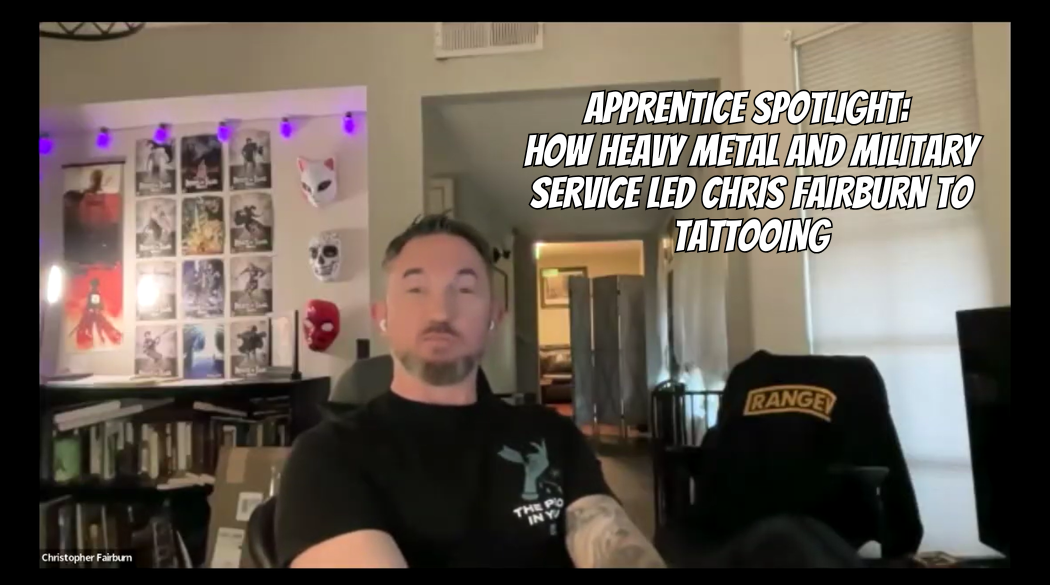
Apprentice Spotlight: How Heavy Metal and Military Service Led Chris Fairburn to Tattooing
Growing up near San Antonio, Chris Fairburn was surrounded by heavy metal, and by musicians with full arms of tattoos. "Seeing musicians with phenomenal pieces down their arms and legs while they're performing on stage was just magnetic," he says. He wanted tattoos and wanted to make them, but there was no path in his neighborhood, and no money to find one. Decades later, after combat deployments, Ranger School, a medical retirement, and two degrees, Chris found that path. He's now in Phase Two of Ink Different's Traditional Tattoo Apprenticeship in San Antonio. In his Apprentice Spotlight interview, he shared how he got here.
Key Takeaways
His spark: Heavy metal and the heavily tattooed musicians he saw growing up.
His service: Three years in Iraq and two in Afghanistan, plus time as a Ranger School instructor.
His art background: A BFA from the Art Institute of San Antonio and a master's in communications.
His practice: Three to four hours a night, most nights, on stacks of practice pads.
His outlook: "I'm going to learn how to do it well. It's something I'm going to enjoy for the latter part of my life."
Who Is Chris Fairburn?
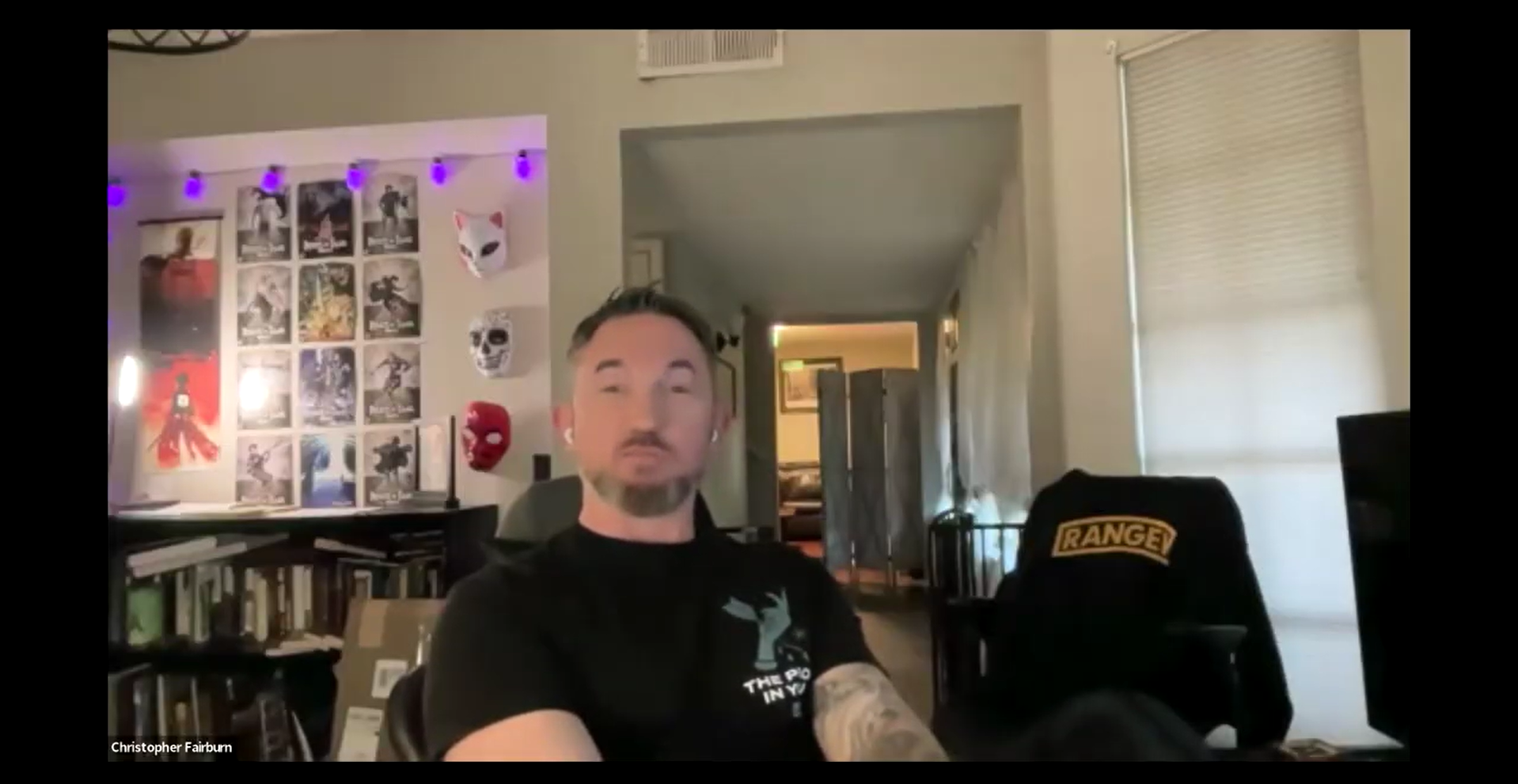
Chris Fairburn is an Ink Different apprentice in San Antonio, Texas. He's an Army veteran, a husband, and a dad. His daughter is in ninth grade.
He was an Army brat, born in Germany. His dad was in the Army and his mom is a German national, so the family moved back and forth between Germany and the U.S. until Chris was about 15. That's when his dad retired in San Antonio.
Today, Chris works as a contractor on Lackland Air Force Base, doing presentation design.
How Did Heavy Metal Spark His Interest in Tattooing?
The neighborhood Chris grew up in was deep into metal, bands like Pantera. His family lived out in the sticks, but whenever they came into town, he'd see people with incredible tattoos.
He wanted to get tattooed and to learn to tattoo, but the opportunity wasn't there. He didn't have a car, and his parents didn't have money to help. "I wish there were the opportunities back then that you've created here," he says. "So I appreciate it a lot more now."
In the metal scene, he says, tattooing and music are closely connected, and local legends about who tattooed which band member were part of the fun.
What Was His Path Through the Military?
Chris drifted in and out of college until 9/11. Then he enlisted. He left for basic training at infantry school the day the U.S. invaded Iraq.
He went on to serve three years in Iraq and two in Afghanistan. He graduated from and taught at Ranger School at Fort Benning. His last assignment was as a platoon sergeant at Fort Hood. He chose it to keep his wife and kids close to family in San Antonio.
He didn't get many tattoos while serving. "When you're a leader, you don't want to get a bunch of ink and then tell your guys, 'Do as I say, not as I do,'" he says. He started getting more after he got out, around 15 years ago.
Eventually, he needed a series of surgeries on his neck and back and was medically retired.
If you're thinking about your own next step after service, here's a look at how military skills can carry into a tattoo career.
How Did He Go From Graphic Design to Tattooing?
After the Army, Chris earned a BFA from the Art Institute of San Antonio, then a master's in communications from the University of the Incarnate Word. He'd started exploring graphic design in college before 9/11, so the field wasn't new to him.
He sees a lot of overlap between graphic design and tattooing. "The elements and principles of design don't change," he says. "Whether it's graphic design or tattooing, you still have to know value, shading, color, line and depth."
The big difference is permanence. "In graphic design, there's an eraser," he says, describing endless Ctrl+Z undos. "Here, you're committed to it, so I've got to make sure that coming out of the gate, I'm as trained as possible."
What Did He Create in Phase One?
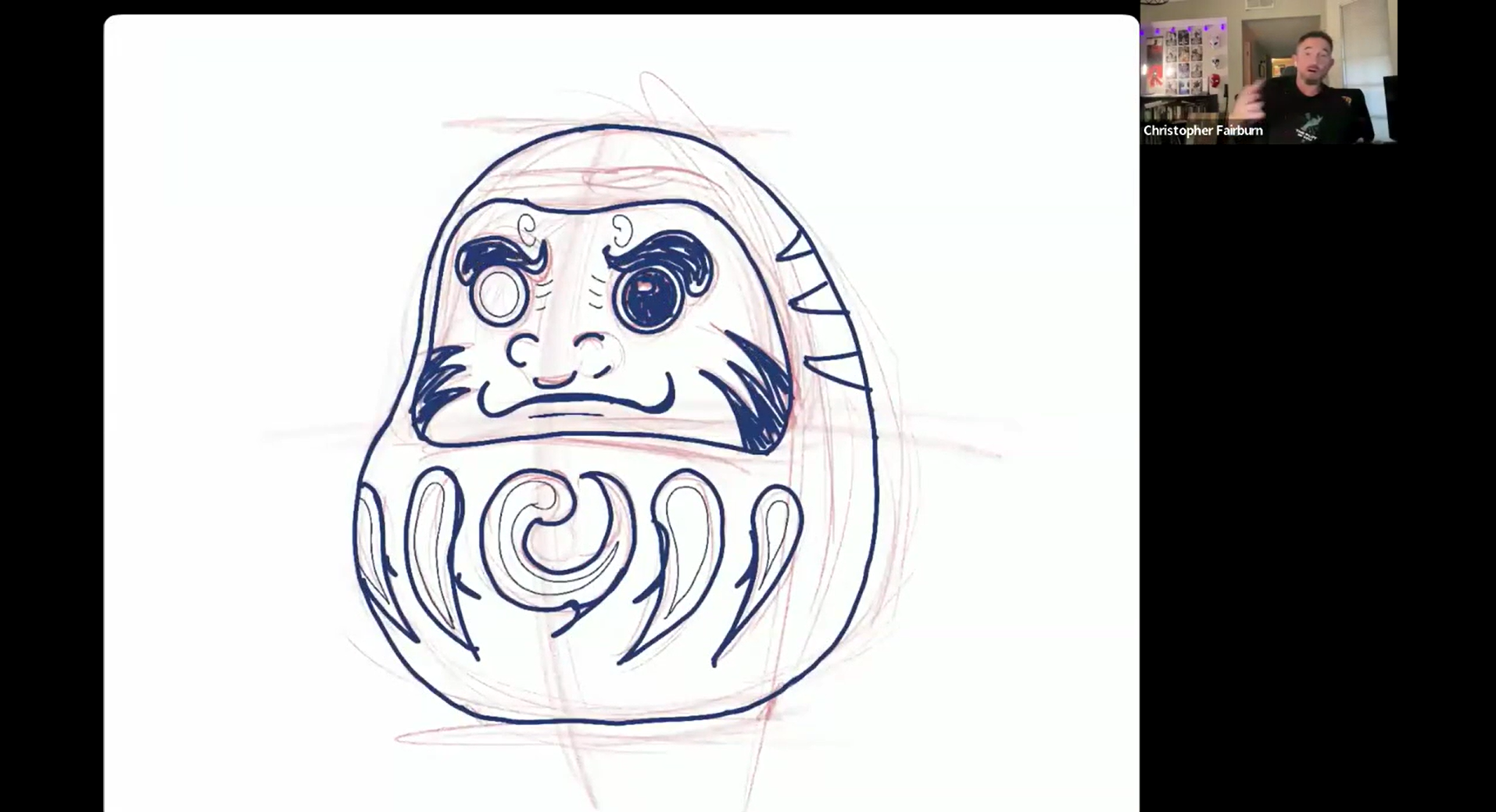
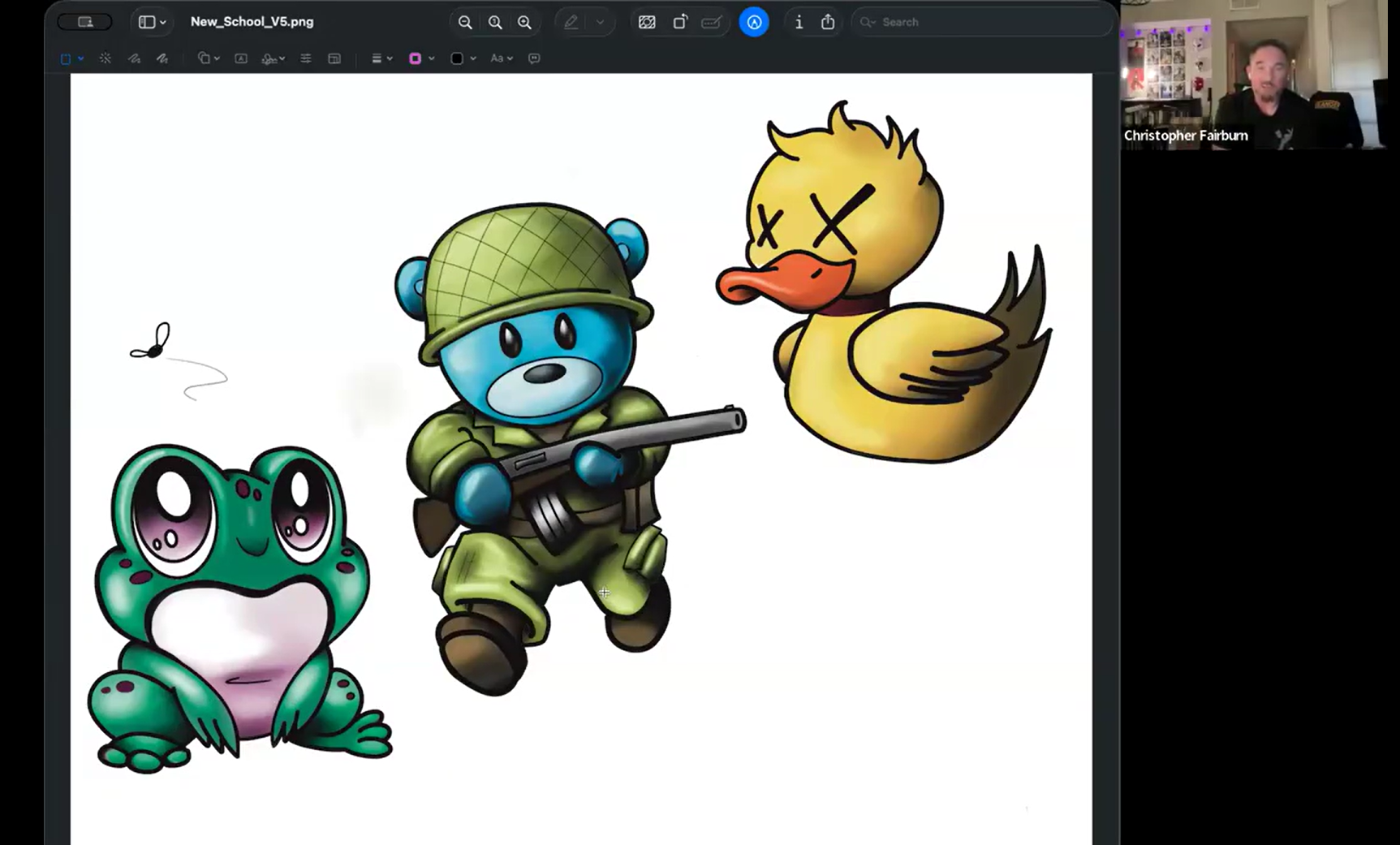
Phase One is art and design. It happens online, before apprentices use a tattoo machine. Apprentices design in four foundational styles: American traditional, neo-traditional, new school, and Japanese.
Japanese
Chris is drawn to Japanese art, partly because of his daughter, who loves anime. "I think of her when I think about the Japanese artwork," he says. "It gives me a good feeling."
He drew a daruma doll, though he didn't know what one was at first. "One of the instructors, Martin, explained the whole eye thing, and it just kind of blew my mind," he says. When he asked his daughter, she gave him "some ninth-grade explanation that was half correct," so he got to be the smart dad for once.
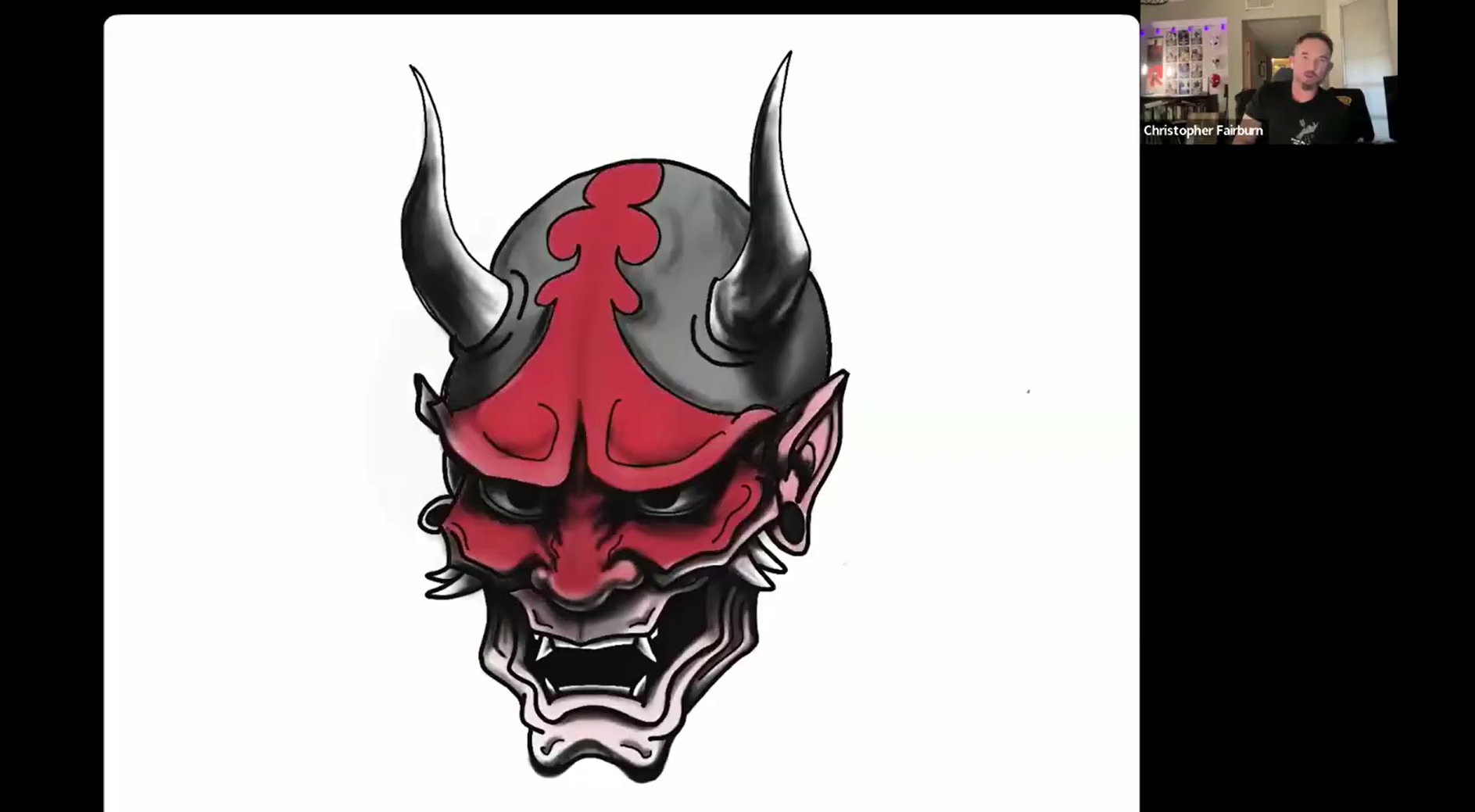
He also drew an oni mask. "When we started learning how to mix the black with the actual color, it was mind-blowing to be able to do it," he says. "To not just live with your artwork, but be happy with it."
New school
"New school was more lighthearted for me," he says. "Because of the bright colors, it's just a lot more fun. It was a joy to do."
American traditional
He gained a new respect for American traditional. "I never really appreciated the nuances and detail of American traditional until I enrolled," he says. "I appreciate the craft more, and I appreciate the history behind it." He especially loves its line weight.
Red pencil sketching
Every design starts with loose red pencil sketches. "You start with loose forms, just sketches, curves, all that stuff, and you develop weight, shape, depth," he says. "The form takes a life of its own, and eventually you make the commitments."
His biggest challenge was the tablet itself. Procreate was new to him, since his day job uses Photoshop and Illustrator with a mouse.
What Is Phase Two Like for Him?
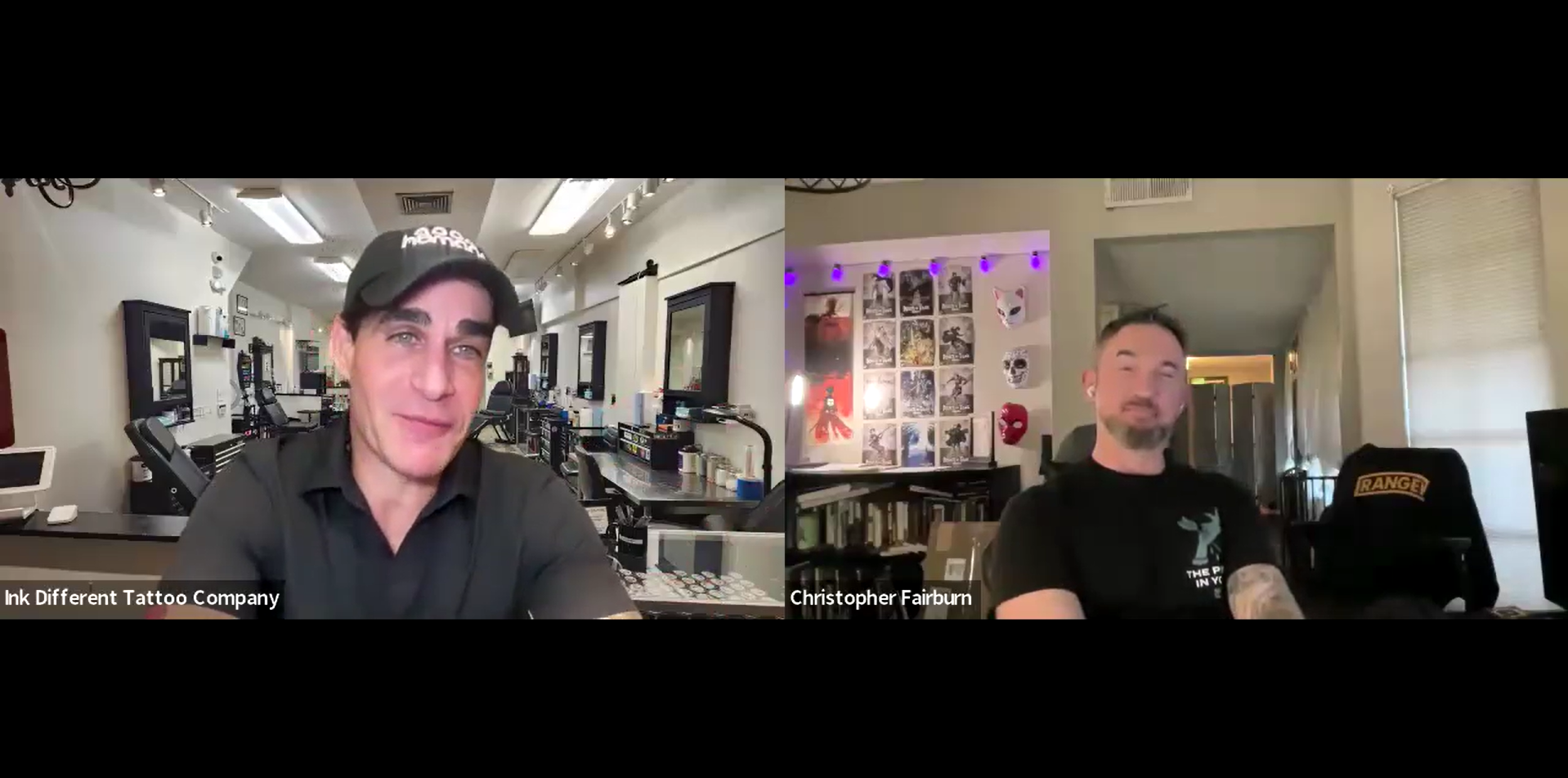
Phase Two is machine practice on synthetic skin, and Chris is putting in serious hours.
"I have stacks and stacks of pads," he says. "I spend three to four hours a night most nights, getting the design down and getting the feel of it. That's stuff that becomes muscle memory."
He describes a good line this way: "It's like cutting a piece of paper with scissors and just gliding across it. It's like hitting the most perfect golf shot, and it keeps you coming back."
He expected to learn on coil machines, with rubber bands and constant tuning. Instead, he's learning on a rotary.
Learning from the greats is part of the process too, and many apprentices study the Tattoo Artists who shaped the craft along the way.
How Do Ink Different's Instructors Compare to College Professors?
Chris has been through college twice, so he has a clear comparison.
"I definitely enjoy the personal side of the Tattoo Artists, because you're actually talking to them," he says. "Some college professors are a little aloof and not really there to help you. The staff here at Ink Different is phenomenal compared to some of the professors I've had."
He's used to critiques from design school, where work went up on the wall in front of everyone. There, he learned to give feedback using a "sandwich": a positive, then what to improve, then another positive. He believes feedback is how you grow. "You're not going to grow in a vacuum," he says. "The only way you grow is through some sort of adversity."
For many people, this kind of training is a real alternative to a traditional degree.
Why Did He Finally Take the Leap?
Once Chris realized Ink Different was a real, structured path, he didn't hesitate. "When I realized this was an actual program, there was no hesitation, because this is something I've always wanted to do," he says.
The old way didn't make sense for him. "Getting out of the military, it's just not economically feasible to say, 'I want to get an apprenticeship, and I'm going to pay somebody for a couple of years to sweep their shop and hopefully I picked a good one,'" he says.
"You only live once, and this is a reputable program," he adds. "So put your feet down, get in here and just knock it out to the best of your ability."
He's honest about starting later in life. "I'm an older guy, but that's okay," he says. "I accept that this is something I'm going to learn how to do, and I'm going to learn how to do it well. It's something I'm going to enjoy for the latter part of my life."
And he knows why he wants it. "Every time I've walked out of a shop with a fresh piece, I'm happy," he says. "There's a story behind it most of the time. It's a beautiful thing to be a part of."
Other veterans have made the same jump, like Army paratrooper Daniel Mercedes, who came back to tattooing after seven years away.
A hope for fellow veterans
After the interview, Chris shared something on his mind. He knew many service members who are phenomenal artists. "If the VA is ever able to help them with the GI Bill once they get out, that would be a great thing," he says. "A program like this definitely lends a lot more credibility to that happening."
If you're a veteran weighing your options, here's more on tattooing as a career for veterans.
Where Will He Train in San Antonio?
Ink Different's San Antonio location is at Dynasty Tattoo Studio, owned by David Lamb. David is known for bold, photorealistic color work and fine-line tattooing.
Here's more on training to become a Tattoo Artist in San Antonio, along with Texas's tattoo licensing steps.
Chris is excited for what's ahead. "I'm excited to get home and just spend my time getting these pads for now," he says, "but when we get in the shop, I'm excited for that, too."
What Does the Traditional Tattoo Apprenticeship Offer?
Ink Different's Traditional Tattoo Apprenticeship is an 18 to 24 month, four-phase tattoo apprenticeship built for beginners. Ink Different has trained Tattoo Artists for 15 years. No prior art experience is required.
Phase One: Art and design, online.
Phase Two: Machine practice on synthetic skin, online. This is where Chris is now.
Phase Three: Supervised tattoos on real clients in a tattoo studio.
Phase Four: Building independence and preparing for licensing.
Safety is part of the training, including the OSHA bloodborne pathogens standard.
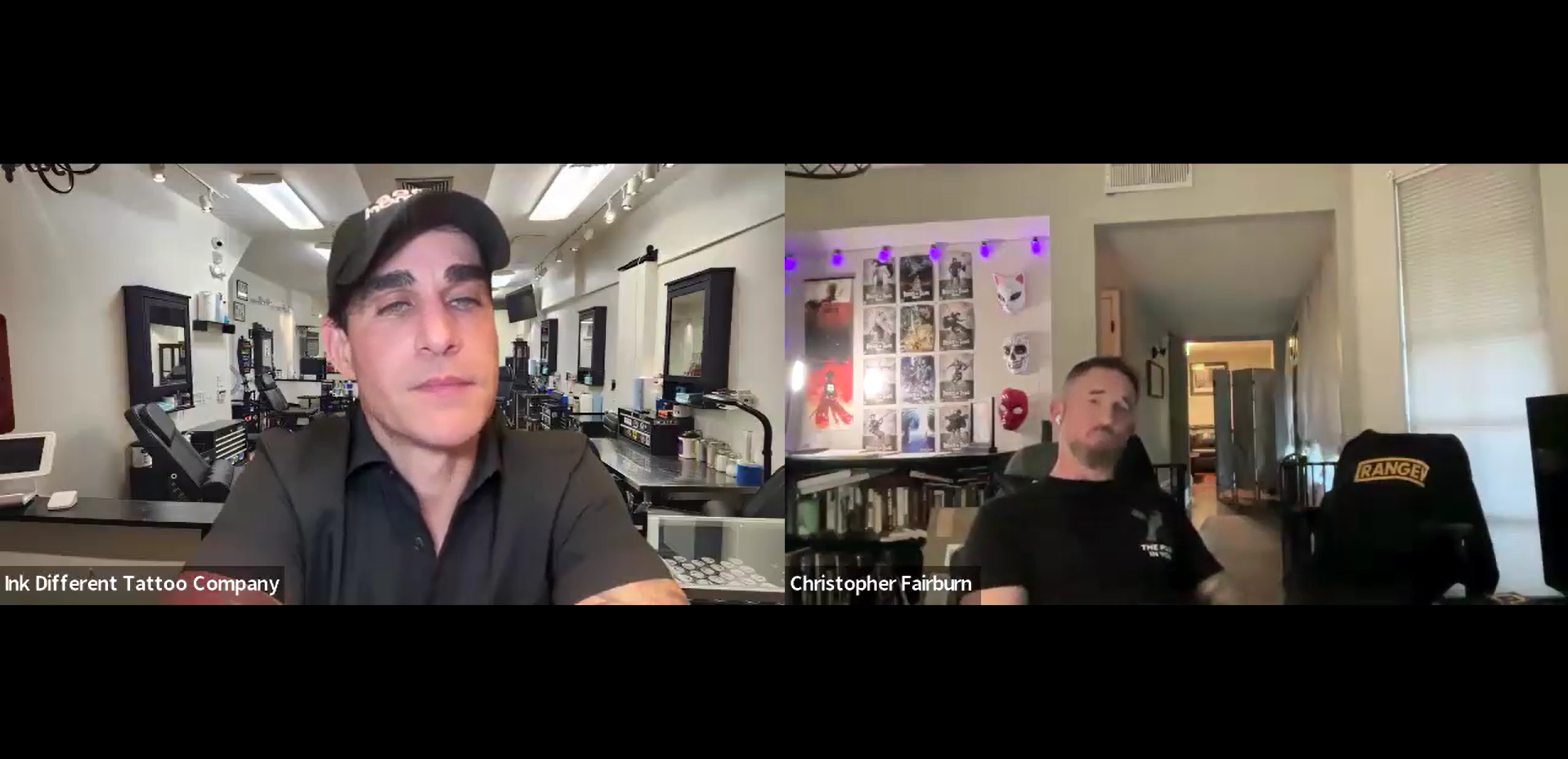
"This program is groundbreaking to me," Chris says. "It didn't exist when I was a kid, and I'm glad it exists now, so I get to do it in my lifetime."
You'll finish with job-ready skills, licensing support, and a guaranteed job offer at one of Ink Different's own tattoo studios. The Traditional Tattoo Apprenticeship is available at 60+ tattoo studios nationwide.
Mentorship That Pushes Your Brand and Skills Further
Once you've built your foundation, Ink Different's Master Mentorship offers advanced training with Master Mentors like Kara Gutierrez and Liz Cook, who are both known for detailed color work.
Making Tattoo Training Accessible for Everyone
Ink Different offers Spanish-speaking locations in Denver, Orange County, NYC, Miami, San Antonio, and San Diego. Seats are limited, with only two apprentices per tattoo studio per Mentor.
Ready to Start Your Own Story?
Ready to become a Tattoo Artist? Apply now to Ink Different's Traditional Tattoo Apprenticeship.
Related guides
Frequently Asked Questions
What led Chris Fairburn to tattooing?
Growing up in San Antonio's heavy metal scene, surrounded by heavily tattooed musicians, sparked his interest. He finally pursued it after his military career and two degrees.
Did Chris have art experience before starting?
Yes. He earned a BFA from the Art Institute of San Antonio and works in presentation design. But the Traditional Tattoo Apprenticeship is built for beginners.
How much does Chris practice?
Three to four hours a night, most nights, on stacks of practice pads.
Is tattooing a good career for veterans?
Many veterans pursue it. Chris served in Iraq and Afghanistan before starting his tattoo apprenticeship.
How long does the Traditional Tattoo Apprenticeship take?
Ink Different's Traditional Tattoo Apprenticeship takes 18 to 24 months across four phases, with licensing support and a guaranteed job offer at one of Ink Different's own tattoo studios.
Can I train in Spanish?
Yes. Ink Different offers Spanish-speaking locations in Denver, Orange County, NYC, Miami, San Antonio, and San Diego.