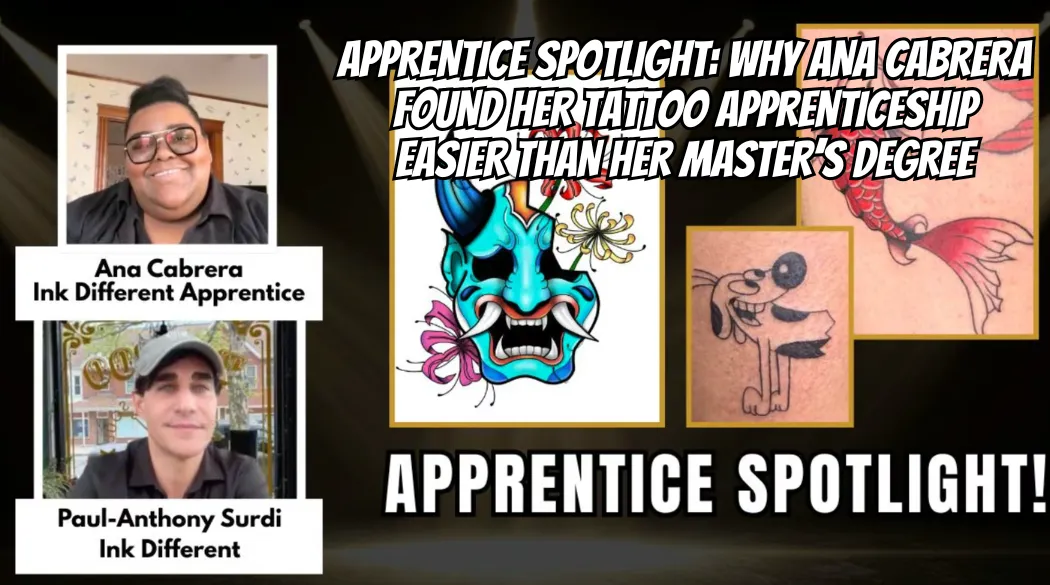
Apprentice Spotlight: Why Ana Cabrera Found Her Tattoo Apprenticeship Easier Than Her Master’s Degree
Ana Cabrera has a master’s degree. She says she questioned her ability, and her sanity, more during regular college than at any point in her tattoo apprenticeship. Today, she’s at the end of Phase Three of Ink Different’s Traditional Tattoo Apprenticeship in New Haven, Connecticut. She’s doing supervised tattoos on real clients and is about to move into Phase Four, the junior artist phase. There, she’ll start charging for her work. Along the way, she admits there were times she wanted to quit. We sat down with Ana to hear what kept her going.
Key Takeaways
Who: Ana Cabrera is an Ink Different apprentice in New Haven, finishing Phase Three and heading into Phase Four.
Why it felt easier: She says the support, attentive instructors, and small class sizes meant she never had to question herself alone.
Her biggest challenge: Trying to force progress and comparing herself to others.
Her turning point: Halfway through Phase Three, when she realized she could successfully apply what she’d learned to real skin.
Her most valuable lesson: Take it one step at a time, and breathe.
Who is Ana Cabrera?
Ana Cabrera is an Ink Different apprentice training toward Ink Different’s New Haven location.
She’s mostly self-taught as an artist. She credits an elementary school teacher who was a big art buff. The way that teacher explained how artwork comes together, and the emotion behind it, made Ana want to try it herself. She stuck with it ever since.
She’d been getting tattooed for many years. People kept telling her how cool her artwork was and that she should become a Tattoo Artist. She sat on the idea for a couple of years. Then she saw an Ink Different ad and decided it was time. She looked into it and saw that it matched what she wanted to learn.
Ana previously worked as a case manager. Now she works at one of her city’s courts, where she records proceedings and types transcripts. She describes it as quiet, though not mindless. That quiet gives her the mental space to let her art grow and balance her training. After a long day, sitting down to practice became a nice way to ease out of work.

Hands-on practice replaced abstract theory for Ana almost immediately.
Why did Ana find her tattoo apprenticeship easier than a master's degree?
Ana says the payoff in skills came much faster than in traditional college.
During her master’s degree, she questioned her ability and her sanity more than she has during her tattoo apprenticeship. The difference, she says, is support. Ink Different’s instructors have a deep backbone of knowledge and a real desire to teach. She never had to question herself in isolation.
Instead, she got redirection, advice, and input on how to approach things without overwhelming herself. That’s something she says she didn’t get in a traditional classroom.
What made the learning feel different?
For Ana, it came down to class size, community, and having more than one Mentor.
Smaller classes
In college, Ana sat in lecture halls with up to 300 people. Her Phase One classes were much smaller. She says it wasn’t a walk in the park, but it was more manageable. She didn’t have to fight for attention to ask a question, and instructors could be more attentive.
Community instead of isolation
Ana felt much more connected to the people in her classes. She says big college classes made her feel more isolated than she needed to be.
Many Mentors, many perspectives
Ana says learning from several instructors is far more helpful than having just one person to learn from. Everyone has different approaches and preferences.
She gives an example. She might describe a dog as a fluffy little animal with four legs. Someone else might call it a strong animal with four legs. It’s the same thing, described differently. Hearing different explanations helped her understand. She also says her instructors genuinely cared about making sure apprentices understood. It made her want to research more and ask more questions.
Leaning on her Mentor
In Phase Three, Ana works closely with her Mentor, Charmaine. Ana laughs that she’s bothered Charmaine constantly, asking how to approach things and what she’d suggest. Having that extra pair of eyes helps her prepare, so she isn’t stressed out when tattoo day comes.
How is a tattoo apprenticeship structured compared to college?
Ink Different’s Traditional Tattoo Apprenticeship moves through four phases, each building on the last. Here’s how Ana experienced them.
Phase One (Art and design): Ana says it was an adjustment. You start with bare-bones designs, and many apprentices come in already skilled, so learning to simplify was a challenge. She discovered she loves Japanese style, especially its use of color. Her final Phase One assignment is still her favorite piece, and it inspired her recent koi tattoo.
Phase Two (Machine practice): When Ana started using a machine, everything clicked. She realized the designs were kept simple so they wouldn’t get overcomplicated or lost in translation. She loved how structured the assignments were and that she could use her own designs at the end. Her biggest challenge was not getting frustrated when she had to redo assignments.
Phase Three (Supervised client work): Moving to real skin was a big shift. She says bodies have very different dips and contours, and depth on skin is different. Charmaine was a huge help, especially at the start, since nobody wants to hurt a client.
Phase Four (Junior artist): Ana is about to start this phase, where she’ll begin charging for her tattoos.
Phases One and Two happen online. Phases Three and Four take place in a tattoo studio under a Mentor’s supervision.
Safety is part of every phase, including the OSHA bloodborne pathogens standard.

Why is a tattoo apprenticeship a real college alternative?
For Ana, it delivered real skills faster, with more support than college ever gave her.
Her supervised tattoos show it. She designed a koi fish for Brandon, one of the permanent Tattoo Artists at her tattoo shop, who wanted to support her. They matched the red and black already on his leg, and talked through details like the flare of the fins and the color application.
She also tattooed a CatDog duo tattoo on two friends. One of them was a coworker from her current job, who got Cat. CatDog was one of Ana’s favorite shows growing up, so she loved the nostalgia.
Her biggest lesson in design was to be realistic. Tiny lines and heavy detail might look great on an iPad, but they don’t always work as tattoos. She learned to keep things simple and let the work speak for itself. More detail can come later.
How can you start your own path like Ana?
Step 1: Stop sitting on the idea. Ana waited a couple of years before applying. Seeing an Ink Different ad gave her the push.
Step 2: Apply. Fill out the questionnaire and apply to the Traditional Tattoo Apprenticeship.
Step 3: Let progress happen. Ana’s biggest Phase One challenge was trying to force progress. She learned to stop comparing herself to others and stop getting too far ahead of herself.
Step 4: Redo the work. Ana says redoing assignments isn’t a punishment. It’s how you learn to pull a clean line with the right depth.
Step 5: Ask questions. Ana says your approach might not be the most effective one. Ask your Mentors how they’d do it.
Step 6: Chase the feeling. Halfway through Phase Three, Ana realized she could successfully apply what she’d learned to real skin. Now she chases that feeling with every tattoo.
What can you expect from our Traditional Tattoo Apprenticeship?
Ink Different’s Traditional Tattoo Apprenticeship is an 18 to 24 month, four-phase tattoo apprenticeship that takes beginners to job-ready Tattoo Artists.
Online foundations: Phases One and Two happen online, so you can train around work.
In-studio training: Phases Three and Four take place in a tattoo studio under a Mentor’s supervision.
Beginner-friendly: No prior experience or art degree required.
Licensing support: Guidance through your state’s requirements, like getting your tattoo license in Texas or transferring a tattoo license to California.
A guaranteed job offer: You’ll receive a guaranteed job offer at one of Ink Different’s own tattoo studios.
This is a career that comes with confidence. You’ll finish with job-ready skills, licensing support, and a guaranteed job offer at one of Ink Different’s own tattoo studios. The Traditional Tattoo Apprenticeship is available at 60+ tattoo studios nationwide.
Ink Different has trained Tattoo Artists for 15 years, with a “Good Humans” culture at its core. Ana felt that support from both her instructors and her fellow apprentices.
What is Master Mentorship?
Once you’ve built your foundation, Ink Different’s Master Mentorship connects you with Master Mentors, including Al Fliction, Liz Cook, Kyle Dunbar, Boneface, Jordi Pla, and Marcel Oliveira.
Ana loved learning from many different Tattoo Artists. Master Mentorship gives Tattoo Artists access to some of the most respected names in the industry.
How are we making Tattoo Artist Training accessible for everyone?
Ink Different offers Spanish-speaking locations in Denver, Orange County, New York City, Miami, San Antonio, and San Diego.
Ana’s online classes also made it possible to train while working full-time. Seats are limited, with only two apprentices per tattoo studio per Mentor.
Ready to become a Tattoo Artist?
Ana Cabrera says there were times she felt frustrated, antsy, and ready to quit. What kept her going was the reminder that tattooing is a skill that takes time and dedication, plus the support of her instructors and her fellow apprentices.
Her advice is simple: take it one step at a time, and breathe.
Ready to become a Tattoo Artist? Apply now to Ink Different’s Traditional Tattoo Apprenticeship and start building an AI-proof career with licensing support and a guaranteed job offer at one of Ink Different’s own tattoo studios. Prefer to test the waters first? Fill out our quick questionnaire to see if it’s right for you.
Frequently Asked Questions
Is it too late to start a tattoo apprenticeship after college?
No. Ana Cabrera started after earning a master’s degree, and she says her tattoo apprenticeship felt far more supportive.
Do I need an art degree to become a Tattoo Artist?
No. Ana is mostly self-taught. The Traditional Tattoo Apprenticeship teaches fundamentals to beginners.
Can I work while doing a tattoo apprenticeship?
Yes. Ana works at her city’s court while training. Phases One and Two happen online.
How long does the Traditional Tattoo Apprenticeship take?
Ink Different’s Traditional Tattoo Apprenticeship takes 18 to 24 months across four phases, with licensing support and a guaranteed job offer at one of Ink Different’s own tattoo studios.
What happens in Phase Four?
Phase Four is the junior artist phase, where apprentices begin charging clients for their work.
What was Ana’s most valuable lesson?
Take it one step at a time, and breathe. She says it’s a skill that takes time and dedication.