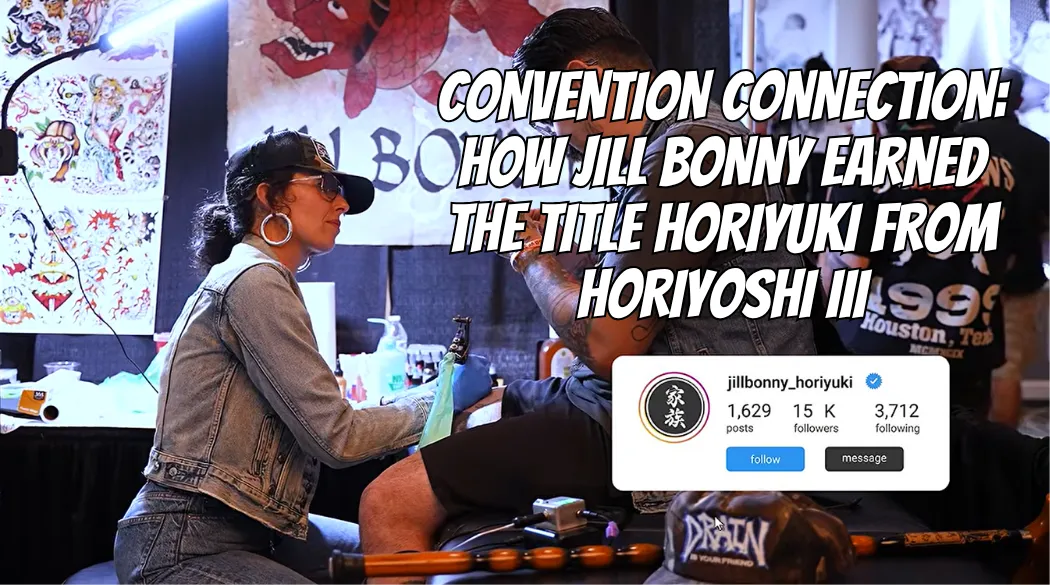
Convention Connection: How Jill Bonny Earned the Title Horiyuki From Horiyoshi III
Jill Bonny’s very first tattoo was on a homeless kid in a New York squat during the punk rock days. Halfway through, her machine shorted out. She rode all the way to Unimax, the city’s go-to tattoo supply shop, got it fixed, rode back, and finished the tattoo. She says she’d never told anyone that story before. Nearly 30 years later, she’s known by another name: Horiyuki, a title given to her in 2008 by Horiyoshi III of Yokohama, one of the most respected masters in Japanese tattooing.
Chico Cortez sat down with Jill at the 50th anniversary of the Texas Tattoo Convention in Houston for Convention Connection.
Key Takeaways
The title: Horiyoshi III gave Jill the name Horiyuki in 2008, on the condition that she commit to Japanese tattooing exclusively.
Her start: She apprenticed with Spider Webb at the tail end of New York City’s tattoo ban, so she began underground.
Before the internet: Every bit of tattoo knowledge was hard-won. She wrote tips in a notebook the moment she heard them.
Her craft lessons: Draw directly on the body as much as you can, and don’t be too proud to trace when it gives the client a better tattoo.
Her commitment: After 30 years, she still feels she has so much to learn in Japanese tattooing.
Who Is Jill Bonny?
Jill Bonny is a Tattoo Artist specializing in Japanese tattooing, known by her title, Horiyuki. This May marks 30 years since she started tattooing.
She’s also a historian of the craft. She’s written books and many articles about Japanese tattooing and tattooing in general, including Studying Horiyoshi III: A Westerner’s Journey Into Japanese Tattoo, published under the name Jill “Horiyuki” Mandelbaum.
Today, she tattoos at Studio Kazoku in San Francisco.
What Does the Title Horiyuki Mean?
Horiyuki is the name Horiyoshi III gave Jill in 2008. In Japanese tattooing, “hori” names are given, not chosen, and receiving one from a master is a rare honor.
Jill never became Horiyoshi III’s apprentice. At the time, she was working at State of Grace in San Jose alongside Taki Kitamura, who was Horiyoshi III’s apprentice. Horiyoshi III recognized her commitment to Japanese tattooing and decided to offer her a title.
It came with a condition. If she accepted the honor and the responsibility, she had to commit to Japanese tattooing exclusively.
Remember: For Jill, the title wasn’t just recognition. It was a promise to change how she worked.
Who Is Horiyoshi III?
Horiyoshi III is a legendary Japanese tattoo master based in Yokohama.
To Jill, he was always the top of the field, the greatest of all time, and the one who sets the standard in Japanese tattooing. She also acknowledges there are many other great masters.
She points out that Horiyoshi III has always been open. He’s shared his work with the world through his books. Instead of telling people not to do Japanese tattooing, she says, he’s done the opposite.
Meeting him was a dream come true. She first got tattooed by him. Later, he invited her to his home, where she stayed with him and returned to watch him tattoo.
How Do Tattoo Conventions Shape Careers?
For Jill, the tattoo community has always been about face-to-face connection, long before conventions were everywhere.
In New York, Unimax was more than a supply shop. Once a month on a Monday night, Tattoo Artists from all over the city and the boroughs would gather to drink and swap stories. Sometimes someone would get on stage and share anecdotes, like news from a convention they’d just attended in Germany.
Jill believes New York City still has the closest-knit tattoo community today. She thinks that camaraderie comes from the underground days, when Tattoo Artists needed each other and had to share information in person.
Conventions keep that spirit alive. They’re where Tattoo Artists meet, share knowledge, and learn from each other.
How Did Jill Bonny Earn the Name?
Jill earned the name through years of devotion to Japanese tattooing, and by changing her career to honor the title.
She started underground
Jill apprenticed with Spider Webb right at the end of New York City’s tattoo ban. Tattooing was illegal in the city until 1997, so she got to start underground. His studio was upstairs near Union Square on 17th Street.
Even though she didn’t spend her whole career under the ban, starting then made tattooing feel sacred and secret. You had to prove yourself to get any information.
She treasured every lesson
No one shared much back then. Jill kept a tattoo notebook. She remembers hearing Bob Roberts say that when you design a back piece, the main subject goes in the middle, because the eye goes to the middle first and then looks around. She ran home and wrote it down.
There was no YouTube and no Amazon. You needed someone to actually tell you.
She was drawn to Japanese tattooing
Japanese tattooing was presented to her as the pinnacle of the craft. It was rooted in history. It was academic, artistic, and large-scale. You had to read books to learn it.
She also had to rethink how she drew. Coming from a Western art background, the field is shallower and the proportions are different. She says even good artists have a lot to relearn.
She moved west to pursue it
Jill left a traditional tattoo shop in Queens where people walked in and picked designs off the wall. She moved to California to work at a Japanese tattoo shop.
She committed when the title came
When Horiyoshi III offered her the title in 2008, there was no internet or Instagram to show her work. Tattoo Artists just had portfolios. So she cleared everything that wasn’t Japanese from hers and focused on promoting her Japanese work.

What Can You Learn From Her Journey?
Jill’s story is full of practical lessons for any Tattoo Artist.
Draw on the body
When Jill first worked in San Jose, she didn’t have many clients yet. The most popular Tattoo Artist in town at the time was Pinky Yun, from Hong Kong. He was about 80 in the early 2000s and has since passed. He was known for bold dragons and tigers.
Many of his clients came to Jill wanting clouds and water added around his work. She had to tuck her designs in between what already existed, so she couldn’t draw them on paper. She had to draw directly on clients.
That pushed her to draw everything on the body. Coming from a street shop where she couldn’t draw anything freehand, she got to a place where she could. She says the more you draw on people’s bodies, the more confident your tattooing becomes.
Don’t be too proud to trace
Jill calls tracing one of the most important skills in tattooing, because the job is to do the best tattoo possible. She credits Mike Malone as a pioneer of tracing. He was also a photographer who photographed skulls from all angles to use as references.
Her advice is to do both. If tracing gives the best result, humble yourself and trace. At the same time, keep sharpening your drawing until your drawings are as good as or better than your tracings.
Adapt to your clients
At the Queens tattoo shop, clients picked flash off the wall. In San Francisco, clients wanted custom work. Her very first San Francisco client brought a black and white photo of a puddle and some dirt, with the camera reflected in the puddle, and wanted it tattooed. She did her best version. She jokes there’s no photo evidence of that tattoo.
Keep learning for life
After 30 years, Jill is still excited by Japanese tattooing. She says it’s a lifetime commitment, and she still feels she has so much to learn, grow, and revisit.
Why Does Live Mentorship Change Everything?
Jill’s career shows how much tattooing depends on learning directly from others.
She learned from Spider Webb, wrote down advice from Bob Roberts, and learned by tattooing alongside other Tattoo Artists. Later, she got to watch Horiyoshi III tattoo in person. Every step came from people who were willing to share what they knew.
Live mentorship also teaches the habits that keep clients safe. Even as a beginner in the squats, Jill tried to do everything right and keep things clean. Every Tattoo Artist should know the OSHA bloodborne pathogens standard.
How Ink Different Builds Real Tattoo Artists
Ink Different Tattoos has trained Tattoo Artists for 15 years through hands-on mentorship. It’s a college alternative for people who want a creative, AI-proof career.
Get Serious About Your Craft With a Traditional Tattoo Apprenticeship
Ink Different’s Traditional Tattoo Apprenticeship is an 18 to 24 month, four-phase tattoo apprenticeship that takes beginners to job-ready Tattoo Artists. No prior art experience is required.
Hands-on training: You learn in person from experienced Mentors inside a working tattoo studio.
Beginner-friendly: You’ll learn fundamentals from the ground up.
Licensing support: Guidance through your state’s requirements.
A guaranteed job offer: You’ll receive a guaranteed job offer at one of Ink Different’s own tattoo studios.
A Career That Comes With Confidence
This is a career that comes with confidence. You’ll finish with job-ready skills, licensing support, and a guaranteed job offer at one of Ink Different’s own tattoo studios. The Traditional Tattoo Apprenticeship is available at 60+ tattoo studios nationwide.
Mentorship That Pushes Your Brand and Skills Further
Once you’ve built your foundation, Ink Different’s Master Mentorship connects you with Master Mentors, including Al Fliction, Liz Cook, Kyle Dunbar, Boneface, Jordi Pla, and Marcel Oliveira.
Making Tattoo Training Accessible for Everyone
Ink Different offers Spanish-speaking locations in Denver, Orange County, NYC, Miami, San Antonio, and San Diego.
Good Humans culture: When you join Ink Different, you join a supportive community. You never have to figure this out alone.
Ready to Begin Your Own Story?
Jill Bonny started tattooing underground in New York, kept every lesson in a notebook, and committed her career to Japanese tattooing. That commitment earned her the title Horiyuki from the master she admired most.
Seats are limited, with only two apprentices per tattoo studio per Mentor.
Ready to become a Tattoo Artist? Apply now to Ink Different’s Traditional Tattoo Apprenticeship and start building an AI-proof career with licensing support and a guaranteed job offer at one of Ink Different’s own tattoo studios. You can also fill out our quick questionnaire to see if it’s right for you.
To book with Jill, visit Studio Kazoku or follow her on Instagram at @jillbonny_horiyuki. Follow Chico at @m4l_chico.

Frequently Asked Questions
Who is Jill Bonny?
Jill Bonny is a Tattoo Artist specializing in Japanese tattooing, with nearly 30 years of experience. She’s also known as Horiyuki and tattoos at Studio Kazoku.
How did Jill Bonny get the title Horiyuki?
Horiyoshi III recognized her commitment to Japanese tattooing and gave her the title in 2008, on the condition that she tattoo Japanese work exclusively.
Was Jill Bonny an apprentice of Horiyoshi III?
No. She worked alongside Taki Kitamura, his apprentice, at State of Grace in San Jose. Horiyoshi III later invited her to his home to watch him tattoo.
Who did Jill Bonny apprentice with?
She apprenticed with Spider Webb in New York City at the end of the city’s tattoo ban.
How long does the Traditional Tattoo Apprenticeship take?
Ink Different’s Traditional Tattoo Apprenticeship takes 18 to 24 months across four phases, with licensing support and a guaranteed job offer at one of Ink Different’s own tattoo studios.