Getting Your First Tattoo After 40: What to Expect
Maybe you've wanted one for 20 years. Or, perhaps you kept telling yourself you'd get it "someday," and someday kept getting pushed further down the road while your job, your responsibilities, and your concern about what other people might think crowded it out. Now you're 40 (or 50, or beyond), and that pull hasn't gone away. It's gotten louder. Getting your first tattoo after 40 is the deeply personal experience of marking your skin with meaningful art later in life, often after years of waiting, reflection, and finally choosing yourself. If that sounds like you, you're in exactly the right place.
Here at Ink Different Tattoos, we've watched countless people walk through this exact doorway. Some come in for a single piece that celebrates a milestone. Others walk out realizing the pull they felt wasn't just about getting tattooed; it was about becoming a Tattoo Artist themselves. Either way, this guide is for you.
Key Takeaways
Age is not a barrier: There is no upper age limit for getting a first tattoo; many people start after 40.
Skin changes matter: Mature skin heals well when you stay hydrated and follow proper aftercare guidelines.
Preparation pays off: Rest, eat, hydrate, and choose a licensed Tattoo Studio for a smoother first session.
It can spark more: Many late-blooming clients discover a passion for creating tattoos, not just wearing them.
A career path exists: Ink Different's Traditional Tattoo Apprenticeship trains beginners of any age for an AI-proof creative career.
Is 40 too old to get your first tattoo?
No, 40 is not too old to get your first tattoo, and there is no age at which the door closes on marking your skin with art that matters to you. Plenty of people get their first piece in their 40s, 50s, 60s, and well beyond.
If anything, getting inked later in life often means you make a more intentional choice. You've had decades to think about what actually matters to you. That story, that symbol, that name: it's earned.
What should you expect during your first tattoo?
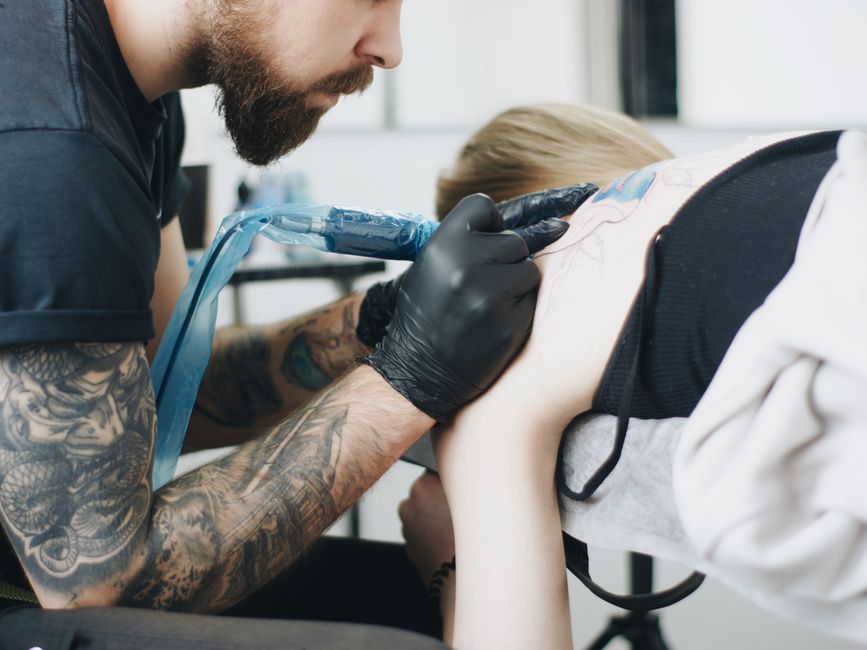
Expect a professional, methodical process: a consultation, stencil placement, a test line, then the tattoo itself, typically lasting 30 minutes to several hours depending on size and detail.
Your Tattoo Artist will start by talking through your idea, placement, and sizing. Then they'll clean and prep the area, apply a stencil so you can approve the design on your skin, and begin with the outline. You'll feel the Tattoo Machine before you even register the pain, and most people find the anticipation was worse than the reality.
Here's what a typical first session looks like:
Consultation: You discuss design, size, and placement with your artist.
Prep: The skin is cleaned, shaved if needed, and the stencil is applied.
Line work: The outline goes down first, defining the shape.
Shading and color: Depth and detail get layered in.
Bandaging: The finished piece is wrapped, and you get aftercare instructions.
Pro Tip: Ask to see the studio's sterilization setup and licensing before you sit down. A reputable Tattoo Shop will be proud to show you.
Does getting a tattoo hurt more after 40?
Getting a tattoo after 40 does not automatically hurt more; thinner or drier skin and bone placement can affect sensitivity, but a skilled Tattoo Artist knows how to manage both.
Pain is deeply individual at any age. What matters far more than the number of candles on your birthday cake is where you place the tattoo, how hydrated your skin is, and how relaxed you stay in the chair. Fleshier areas like the outer arm or thigh tend to be gentler than ribs, ankles, or the tops of the hands.
Well-hydrated, well-cared-for skin takes ink beautifully at any age. The health of your skin is central to the craft, and it's exactly why hygiene standards like the OSHA bloodborne pathogen standards exist to protect both you and your artist.
How do you prepare for your first tattoo?
Prepare for your first tattoo by resting, eating a solid meal, hydrating well, avoiding alcohol, and choosing a licensed Tattoo Studio with an artist whose portfolio you trust. A little planning makes the whole experience smoother.
Step 1: Do your homework. Research artists and studios. Look at healed work, not just fresh photos, and read reviews.
Step 2: Choose the right placement. Think about visibility, pain tolerance, and how the design fits the natural lines of your body.
Step 3: Fuel up. Eat a real meal a couple of hours before, and drink plenty of water the day before and the day of.
Step 4: Skip the alcohol. Avoid drinking the night before, since it can thin your blood and affect how you sit through the session.
Step 5: Dress smart. Wear comfortable clothing that gives your artist easy access to the area being tattooed.
Step 6: Show up early and calm. Arrive a few minutes ahead, breathe, and trust the process.
If this curiosity about the craft is starting to feel like more than a one-time thing, you might already be thinking like a future artist. Beginners often make avoidable errors early on, which is why we wrote about the mistakes aspiring tattoo apprentices should avoid.
How do you take care of a new tattoo?
Care for a new tattoo by keeping it clean, moisturized, and out of direct sun, following your artist's instructions and trusted medical guidance for the two- to four-week healing window.
Aftercare is where a lot of first-timers get nervous, but the routine is simple. Gently wash the area with clean hands and mild soap, pat it dry, and apply a thin layer of the recommended ointment or lotion. Don't pick, don't scratch, and don't soak it in a pool or bath while it heals.
Mature skin heals well when you support it. Stay hydrated, protect the piece from the sun, and be patient as it scabs and settles. For a reliable overview of healing and skin health, the American Academy of Dermatology tattoo care guidelines are a trustworthy resource.
Warning: If you notice spreading redness, heat, or discharge beyond normal healing, contact a medical professional. Proper aftercare protects your investment.
What if your first tattoo sparks a bigger calling?
Sometimes getting tattooed later in life wakes up a creative hunger you buried years ago, and that spark can become the beginning of an entirely new career as a Tattoo Artist.
You'd be surprised how often this happens. Someone comes in stuck in a job that drains them, gets their first piece, and suddenly can't stop thinking about the person on the other side of the Tattoo Machine. They wonder: could that be me?
Here's the truth we tell everyone who asks: it is never too late to change your life. If you've spent decades pouring your creative potential into work that doesn't fulfill you, tattooing offers something rare: a hands-on, human, AI-proof craft that still needs real artists.
Getting Serious About Tattooing With Become A Tattoo Artist
Ink Different Tattoos offers a Traditional Tattoo Apprenticeship built specifically for beginners of any age, a proven college alternative that has trained professional Tattoo Artists since 2011.
You don't need prior art experience, and you're not too old. Our Traditional Tattoo Apprenticeship is a hands-on, 18 to 24 month, four-phase tattoo apprenticeship where you train in real tattoo studios. You learn the fundamentals, build real skill, and prepare for the working world with licensing support and job-ready training along the way.
Why a career in tattooing works at any age
The goal is to make you genuinely job-ready, not to hand you a certificate and wish you luck. You'll finish with the practical skills, hygiene knowledge, licensing support, and a guaranteed job offer at one of our tattoo studios so you can step into a professional role with confidence. If you're weighing this against traditional schooling, our piece on tattoo apprenticeships as a college alternative lays out why so many career-changers make the leap.
Mentorship that pushes your brand and skills further
If you already have some art background or you want to master a specific style, our one-year, in-person Master Mentorship pairs you with celebrity and award-winning Mentors like Al Fliction, Liz Cook, Kyle Dunbar, Boneface, and Jordi Pla. It's intensive skill development for serious growth, including business ownership.
Making tattoo training accessible for everyone
We believe great mentorship shouldn't be lost in translation. That's why we offer Spanish-speaking locations in Denver, Orange County, NYC, Miami, San Antonio, and San Diego. Wherever you are, live in-person mentorship from real working artists is what sets our tattoo apprenticeship apart.
Our "Good Humans" culture means you're never doing this alone. You join a family-like community that wants you to succeed.
Remember: Seats in our hands-on tattoo apprenticeship are limited by the nature of personalized, live mentorship. If this is calling you, don't wait for another "someday."
Ready to Become a Tattoo Artist?
Getting your first tattoo after 40 is proof you're done waiting on your own life. Maybe that piece is exactly what you needed, and maybe it's the first line in a bigger story where you're the one holding the tattoo machine.
Ready to become a Tattoo Artist? Apply now to Ink Different's Traditional Tattoo Apprenticeship and start building an AI-proof creative career, with licensing support along the way. Or fill out our quick questionnaire to get personalized support and find out if the Traditional Tattoo Apprenticeship is right for you.
Frequently Asked Questions
Is it weird to get my first tattoo after 40?
Not at all. Many people get their first tattoo in their 40s, 50s, and beyond. Late-in-life tattoos are often more meaningful because they reflect years of intentional thought and personal reflection.
Am I too old to become a Tattoo Artist?
No. Ink Different's Traditional Tattoo Apprenticeship welcomes beginners of any age with no prior experience required. What matters is your commitment to learning the craft, not your birthday.
How long does the Traditional Tattoo Apprenticeship take?
The Traditional Tattoo Apprenticeship runs 18 to 24 months through a 4-Phase structure. You start remote and finish hands-on in real Tattoo Studios with live mentorship from award-winning artists.
What makes Ink Different different from a tattoo school?
Ink Different offers live, in-person mentorship from award-winning artists, a college alternative rooted in real studio work, and a supportive "Good Humans" community, backed by experience training professionals since 2011.
Will getting a tattoo hurt more because of my age?
Age itself does not increase pain. Placement, skin hydration, and how relaxed you stay matter more. Well-cared-for mature skin takes ink beautifully at any age.
Do you offer training in Spanish?
Yes. Ink Different has Spanish-speaking locations in Denver, Orange County, NYC, Miami, San Antonio, and San Diego, making live mentorship accessible for more aspiring Tattoo Artists.
Related reading: tools every beginner tattoo artist should know, start your tattoo apprenticeship this spring, and why spring is the best time to become a tattoo artist.