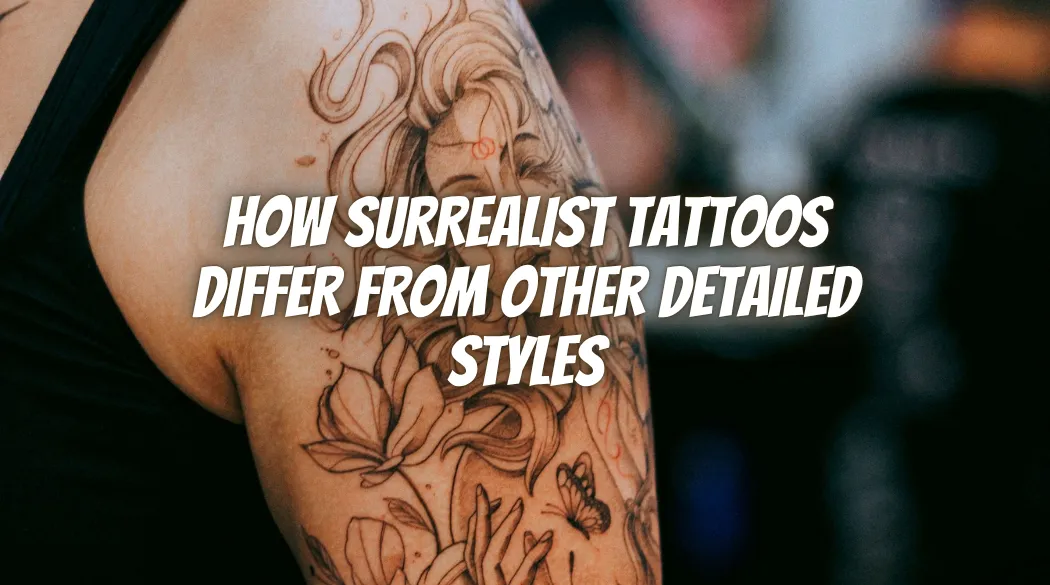
How Surrealist Tattoos Differ From Other Detailed Styles
If you sketch strange, melting shapes in the margins of your notebook, surrealist tattooing may be the style for you. Surrealist tattooing is a detailed tattoo style that blends dreamlike, impossible imagery with technical precision, bending reality the way Salvador Dali bent clocks. At Ink Different Tattoos, we train aspiring Tattoo Artists to turn that kind of imagination into a real, working career.
Key Takeaways
Definition: Surrealist tattoos combine realistic rendering with impossible, dreamlike imagery that defies normal logic.
Key difference: Realism copies what exists; surrealism invents scenes that could never exist in the real world.
Skill demand: Surrealism requires strong drawing, composition, and concept-building on top of advanced shading technique.
Training path: A structured Traditional Tattoo Apprenticeship teaches these fundamentals from scratch, no prior art degree needed.
Career outlook: Tattooing is a hands-on, AI-proof craft with real licensing support through Ink Different.
What Are Surrealist Tattoos?
Surrealist tattoos are detailed, imaginative designs that fuse realistic technique with dreamlike, illogical imagery, creating scenes that feel both believable and impossible at the same time.
Think of a pocket watch dripping off a tree branch, an eye floating in a desert sky, or a face dissolving into a flock of birds. Surrealism borrows the technical skill of realism but throws the rulebook of logic out the window. The goal is to make the viewer feel something strange and unexplainable.
The style traces back to the early 20th-century surrealist art movement, championed by painters like Salvador Dali and René Magritte. According to the Museum of Modern Art, surrealism was built on dream logic and the subconscious mind. Tattoo artists adopted those same principles and translated them onto skin.

How Do Surrealist Tattoos Differ From Realism?
Realism faithfully recreates real subjects like portraits and animals, while surrealism uses those same realistic techniques to build impossible, imagined scenes that could never exist in life.
A realism tattoo of your grandmother aims to look exactly like the photo. A surrealist tattoo might blend your grandmother's face into a blooming rose or scatter her portrait across a shattered mirror. The shading skills are the same, but the intent is completely different.
The biggest difference comes down to concept. In realism, the reference does most of the thinking for you. In surrealism, you invent the reference, which means you need both the technical skill of a realist and the imaginative range of a storyteller.
Pro Tip: If you love realism but feel boxed in by copying photos, surrealism may be your natural next step. It rewards the artist who wants to build worlds, not just reproduce them.
Why Are They Different From Neo-Traditional and Illustrative Work?
Neo-traditional and illustrative tattoos use bold outlines and stylized forms, while surrealism leans on soft, realistic transitions and seamless blending with little or no hard linework.
Neo-traditional work celebrates the line. It has crisp, confident outlines and a flat, decorative color palette rooted in classic American tattooing. You can usually spot it instantly.
Surrealism, by contrast, tries to erase the line. The transitions between objects feel fluid, like one thing is dissolving into another. This demands careful control of gradients, saturation, and negative space so the eye flows through the piece without snagging.
Neo-traditional: Bold outlines, limited color palette, decorative and graphic.
Illustrative: Sketchy or painterly line-driven look inspired by illustration.
Realism: Faithful photo-accurate rendering of real subjects.
Surrealism: Realistic technique applied to impossible, dream-logic compositions.
What Skills Does Surrealism Demand From You?
Surrealist tattooing demands strong drawing fundamentals, composition, smooth shading, color theory, and the ability to design original concepts, all layered on top of safe, confident machine control.
You cannot fake your way through surrealism. Because you are inventing the entire scene, weak drawing or clumsy composition shows immediately. This is the style that separates true craftspeople from quick copyists.
Many aspiring artists assume they need an art degree first. You do not. What you need is structured, repeatable practice in the right order. Jumping straight to advanced work without foundations is one of the most common missteps.
You will also need rock-solid safety habits. Complex surrealist pieces often mean longer sessions, so understanding hygiene is non-negotiable. The OSHA bloodborne pathogen standards are the baseline every serious studio follows.

How Can You Start Learning Surrealist Tattooing?
You can start learning surrealist tattooing by mastering drawing and shading fundamentals first, then progressing through structured, Mentor-guided phases until you can design and execute original dreamlike pieces.
You should not try to teach yourself from online video clips. Here is a realistic path forward.
Step 1: Build your drawing foundation. Train line control, value studies, and anatomy so your imagination has the tools to execute.
Step 2: Learn machine handling and safety. Get comfortable with your tattoo machine and lock in hygiene fundamentals before any skin work.
Step 3: Practice shading and blending. Surrealism lives in smooth gradients, so drill soft transitions on practice skin.
Step 4: Develop original concepts. Start sketching impossible scenes and composing them to read clearly on the body.
Step 5: Work live under a mentor. Apply everything on real clients with an experienced tattoo artist guiding you.
If you want the right gear to practice with, start with our breakdown of the tools every beginner tattoo artist should know.
Where Can You Train in These Detailed Styles?
Ink Different Tattoos offers a Traditional Tattoo Apprenticeship that teaches detailed styles from the ground up over 18 to 24 months, with live mentorship and licensing support.
We have spent over 15 years training aspiring Tattoo Artists to work professionally. Our nationwide tattoo apprenticeship is a serious college alternative for people who want to master a real craft.
Our Traditional Tattoo Apprenticeship is a personalized, four-phase experience. You train hands-on in working tattoo studios surrounded by professionals. No prior experience is required, which means beginners who have never sold a drawing can still build toward a demanding style like surrealism.
What You Can Expect From Our Traditional Tattoo Apprenticeship
Length: 18 to 24 months of hands-on, progressive Tattoo Artist training.
Format: Hands-on training in real tattoo studios under live Mentor guidance.
Who it is for: Beginners welcome, no formal art background needed.
Outcome: Job-ready skills, licensing support, and a guaranteed job offer at one of our tattoo studios.
A Career That Comes With Confidence
Tattooing is a hands-on, human craft. A machine cannot read a client's story and reinvent it as a dreamlike scene on their arm. That is why we call it an AI-proof career. You graduate with job-ready skills, licensing support, and a guaranteed job offer at one of our tattoo studios. For broader context on the craft and fine arts field, the Bureau of Labor Statistics tracks this growing creative sector.
How Do You Go Even Deeper With Your Style?
Ink Different's Master Mentorship is a one-year, in-person program where beginner and experienced artists train with celebrity and award-winning Mentors to master a specific style and build a brand.
If surrealism is the style you want to own, the Master Mentorship is the way to go deep. You train alongside Mentors like Al Fliction, Liz Cook, Kyle Dunbar, Boneface, and Jordi Pla, who have built careers on the intensive skill development surrealism requires. This path is built for career growth and business ownership.
Making Tattoo Training Accessible for Everyone
Ink Different operates nationwide, with the Traditional Tattoo Apprenticeship available in 60+ locations, including Spanish-speaking locations in Denver, Orange County, NYC, Miami, San Antonio, and San Diego, so language never blocks your path. Seats are limited.
Ready to Build Your Future in Ink?
Surrealism, realism, neo-traditional: every detailed style starts with the same decision to stop waiting and start training.
Ready to become a tattoo artist? Apply now to Ink Different's Traditional Tattoo Apprenticeship and start building an AI-proof career with licensing support along the way. Prefer a softer first step? Fill out our quick questionnaire to get personalized support and find out if our Traditional Tattoo Apprenticeship is right for you.
Frequently Asked Questions
What makes surrealist tattoos different from realism tattoos?
Realism recreates real subjects accurately, while surrealism uses the same realistic technique to build impossible, dreamlike scenes. The main difference is concept: surrealism invents imagery rather than copying it.
Do I need an art degree to learn surrealist tattooing?
No. Ink Different's Traditional Tattoo Apprenticeship teaches drawing, shading, and composition from scratch. Beginners with no formal art background can build toward advanced detailed styles with structured mentorship.
How long does the Traditional Tattoo Apprenticeship take?
Ink Different's Traditional Tattoo Apprenticeship takes 18 to 24 months using a personalized four-phase structure of hands-on training inside working tattoo studios.
What makes Ink Different Tattoos unique?
Ink Different has trained professional Tattoo Artists for over 15 years, offering live in-person mentorship, award-winning Mentors, and a supportive Good Humans culture as a college alternative.
Is tattooing really an AI-proof career?
Yes. Tattooing is a hands-on, human craft requiring personal connection, trust, and real-time skill on living skin. No machine can replace an artist interpreting a client's story.
Are there Spanish-speaking training locations?
Yes. Ink Different operates nationwide, with the Traditional Tattoo Apprenticeship available in 60+ locations, including Spanish-speaking locations in Denver, Orange County, NYC, Miami, San Antonio, and San Diego.