How Tattoo Ink Is Actually Made and What Goes Into It
Tattoo ink is a suspension of solid color pigments evenly dispersed in a liquid carrier solution that delivers and stabilizes those pigments beneath the skin. Knowing what is in the bottle affects how a tattoo heals, how long the color lasts, and how safe it is for your client. At Ink Different Tattoos, we believe knowing your materials from the inside out is where real mastery begins, whether you are getting inked or learning to tattoo yourself.
Key Takeaways
Two core parts: Tattoo ink is made of pigment (the color) and a carrier (the liquid that delivers it).
Pigment sources: Pigments come from mineral, metal oxide, or modern synthetic organic compounds.
Carrier job: Carriers like purified water, glycerin, and witch hazel keep pigment sterile and evenly suspended.
Safety first: Reputable inks follow sterility standards and OSHA bloodborne pathogen practices in the studio.
Why it matters: Knowing ink composition helps you choose quality products and protect your clients' skin.
What is tattoo ink actually made of?
Tattoo ink is made of two essential components: pigment particles that create the color and a carrier liquid that transports and stabilizes those particles under the skin. Everything else is a variation on this partnership.
The pigment is what produces the visible color. The carrier lets that pigment stay evenly suspended in the bottle and move smoothly into the skin. Without both working together, the ink will not perform.
The quality of both ingredients determines how your work heals, how long colors stay crisp, and how safely the ink interacts with human skin. That is why serious Tattoo Artists treat ink selection as a craft decision, not an afterthought.
Where do tattoo ink pigments come from?
Tattoo ink pigments come from three main sources: naturally occurring minerals, metal oxides, and modern synthetic organic compounds engineered for consistency and brightness. Each source brings different strengths to your palette.
Historically, Tattoo Artists relied on raw materials straight from the earth. Carbon and soot made black, iron oxides made reds and browns, and various mineral salts produced earthy tones. Some of those traditions still influence modern formulas.
Today, most professional inks use refined pigments for predictability:
Black: Often derived from carbon-based compounds for deep, stable saturation.
Reds and yellows: Historically metal oxides, now frequently synthetic organics for cleaner tones.
Blues and greens: Commonly copper-based compounds like phthalocyanine.
Whites: Typically titanium dioxide, prized for its opacity.
Modern manufacturers increasingly favor organic pigments. In ink chemistry, that term refers to carbon-based pigment molecules, not necessarily natural ones. According to Dataintelo's tattoo ink market report, organic pigments made up about 52.3% of the ingredient market in 2025. They are also the fastest-growing segment, at a projected 7.1% annual rate.
What is a carrier solution and why does it matter?
A carrier solution is the sterile liquid that suspends pigment evenly, keeps it from clumping, and carries it safely into the dermis during tattooing. It is what makes clean, consistent lines possible.
Common carrier ingredients include purified or distilled water, glycerin, witch hazel, and sometimes isopropyl alcohol. Each serves a purpose. Water thins and disperses, glycerin smooths application, and witch hazel can aid flow and comfort.
The carrier also keeps the ink stable on the shelf and sanitary in the bottle. A poorly formulated carrier can let pigment settle, separate, or harbor contamination, which is why professional-grade inks are carefully engineered.
Pro Tip: Always shake your ink and inspect for separation before a session. Consistency in the bottle translates to consistency in the skin.
How is tattoo ink made step by step?
Tattoo ink is made by refining pigment, blending it into a sterile carrier, milling it to a uniform particle size, then testing and packaging it under sanitary conditions. Here's how that process unfolds.
Step 1: Select and refine pigment. Manufacturers choose pigments and purify them to remove impurities and unwanted heavy metals.
Step 2: Prepare the carrier. Purified water, glycerin, witch hazel, and other agents are measured and combined into a sterile base.
Step 3: Blend pigment into carrier. The refined pigment is dispersed into the carrier under controlled, clean conditions.
Step 4: Mill the mixture. The blend is ground or milled so pigment particles reach a consistent, fine size for smooth application.
Step 5: Test and sterilize. Reputable makers test for stability, color accuracy, and contamination, aiming for sterile, shelf-stable product.
Step 6: Bottle and label. Finished ink is sealed in sanitary containers with batch and ingredient information.
Understanding this chain helps you read labels like a professional and spot the difference between hobby-grade ink and products built for a real tattoo studio. The right knowledge keeps you from the mistakes aspiring tattoo apprentices should avoid.

Why do certain tattoo ink colors behave differently?
Tattoo ink colors behave differently because pigment type, particle size, and opacity vary from color to color, affecting how each one saturates and heals in the skin.
Blacks and deep blues usually heal strong and hold their edges because of dense, stable pigments. Lighter colors like yellows and whites can be trickier: they're more translucent and may require layering to read clearly on the skin.
Skin tone, depth of application, and aftercare all influence the final result too. That's why the American Academy of Dermatology tattoo care guidelines matter just as much as the ink itself. A great artist understands both the chemistry and the healing.
Learning how pigment behavior interacts with your tools every beginner tattoo artist should know is exactly the kind of hands-on knowledge you can't fully learn from a video.
What makes tattoo ink safe to use?
Tattoo ink is safe when it is manufactured sterile, free of harmful contaminants, and used in a studio that follows strict hygiene and bloodborne pathogen standards. Safety is a shared responsibility between the maker and the artist.
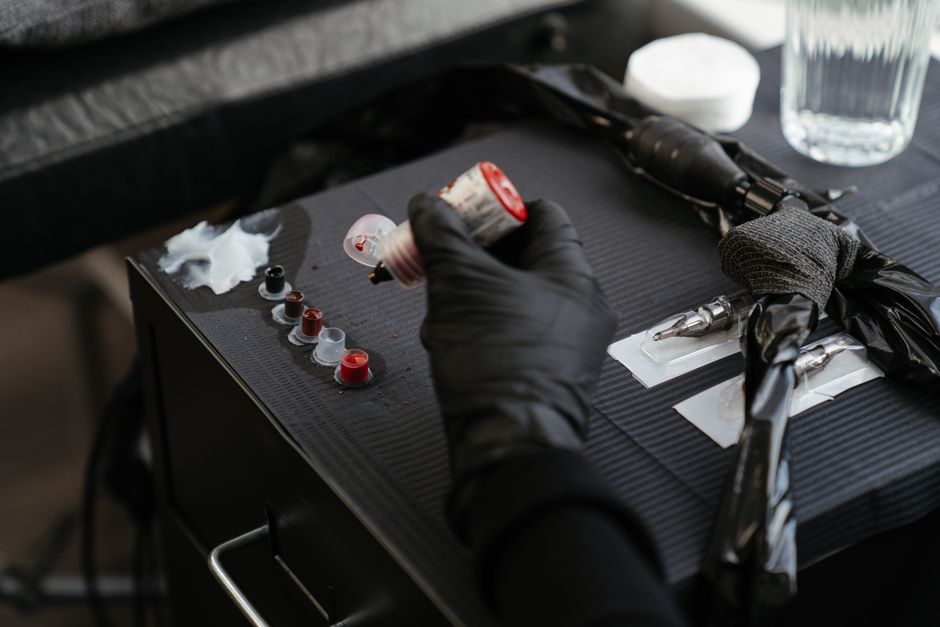
Reputable manufacturers test for heavy metals and microbial contamination. But the artist controls the other half: sterile single-use ink caps, clean stations, and compliance with OSHA bloodborne pathogen standards that protect both you and your clients.
This is where real mentorship becomes priceless. Reading about sterility is one thing. Having a licensed mentor watch over your shoulder as you set up a safe, compliant station is how you actually internalize it.
Warning: Never reuse ink from a cap, and never top off a used cap with fresh ink. Cross-contamination is a serious health risk you must eliminate.
Why should aspiring Tattoo Artists understand ink composition?
Understanding ink composition helps you choose quality products, deliver results that heal beautifully, and build the trust that turns first-time clients into lifelong ones. Knowledge is the root system beneath a thriving career.
You're not just making marks. You're depositing permanent material into living skin, which means your material choices carry real weight. Clients trust you to know what you're putting in their bodies.
This kind of craftsmanship is also what keeps the profession human. As we explore in our piece on why tattoo artists are still essential, machines can't replicate the judgment, empathy, and hands-on skill a trained artist brings. According to the Bureau of Labor Statistics on craft and fine artists, skilled creative work continues to hold real value, and tattooing is one of the most AI-proof crafts out there.
If you've been stuck in a job that wastes your creative potential, this is the kind of career where your knowledge compounds every single year. The question isn't whether you're capable. It's whether you're ready to start.
Get Serious About Your Craft With Ink Different Tattoos
Ink Different Tattoos is a college alternative that trains aspiring Tattoo Artists through live, in-person mentorship, built on 15 years of experience since our founding in 2011. We teach you the craft from the ground up, ink composition included.
You do not learn how ink heals, how to keep a station safe, or how to read a client's skin from scrolling. You learn it standing next to someone who has done it thousands of times.
What You Can Expect from our Traditional Tattoo Apprenticeship
Our Traditional Tattoo Apprenticeship runs 18 to 24 months through a structured four-phase process. You train hands-on in real tattoo studios, with personalized instruction the whole way.
Beginner-friendly: No prior art experience required. We build your foundation from day one.
Hands-on training: Learn materials, safety, and technique under working professionals.
Real studio experience: Work alongside Mentors in professional tattoo studios.
Licensing support: We guide you toward job-ready skills and the credentials you need.
A Career That Comes With Confidence
When you finish, you walk away with job-ready skills, licensing support, and a guaranteed job offer at one of our tattoo studios. This is an AI-proof craft built on human skill, not a passing trend.
Mentorship That Pushes Your Brand and Skills Further
Ready to level up fast? Our Master Mentorship is a one-year, in-person training track alongside celebrity and award-winning Mentors like Al Fliction, Liz Cook, Kyle Dunbar, Boneface, and Jordi Pla. It is ideal for mastering a specific style, growing your career, and learning business ownership.
Making Tattoo Training Accessible for Everyone
Ink Different operates nationwide, with the Traditional Tattoo Apprenticeship available in 60+ locations, including Spanish-speaking locations in Denver, Orange County, NYC, Miami, San Antonio, and San Diego. Our Good Humans culture means you join a supportive, family-like community from the moment you start.
Ready to Become a Tattoo Artist?
You now understand what goes into the ink. The next step is the training, the mentorship, and the decision to start. Seats in our tattoo apprenticeship are limited, because real mentorship cannot be mass-produced.
Ready to become a Tattoo Artist? Apply now to Ink Different's Traditional Tattoo Apprenticeship and start building an AI-proof career with licensing support along the way. Not sure yet? Fill out our quick questionnaire to get personalized support and find out if our Traditional Tattoo Apprenticeship is right for you.
Related reading: career change tattoo apprenticeship and start your tattoo apprenticeship this spring.
Frequently Asked Questions
What is tattoo ink made of?
Tattoo ink is made of pigment and a carrier solution. The pigment provides color, while the carrier, often purified water, glycerin, and witch hazel, suspends and delivers it safely into the skin.
Where do tattoo pigments come from?
Tattoo pigments come from minerals, metal oxides, and modern synthetic organic compounds. Most professional inks today use refined synthetic pigments because they heal more predictably and deliver consistent color.
Is tattoo ink safe?
Tattoo ink is safe when manufactured sterile and used in studios that follow hygiene rules and OSHA bloodborne pathogen standards. Both the ink maker and the artist share responsibility for safety.
Do I need to know ink chemistry to become a Tattoo Artist?
You don't need a chemistry degree, but understanding ink composition helps you choose quality products and protect clients. Ink Different's Traditional Tattoo Apprenticeship teaches this hands-on from the start.
How long does the Traditional Tattoo Apprenticeship take?
Ink Different's Traditional Tattoo Apprenticeship takes 18 to 24 months through a structured 4-Phase program. You start remote and finish in real Tattoo Studios with licensing support.
Do I need art experience to start a tattoo apprenticeship?
No prior art experience is required. Ink Different's Traditional Tattoo Apprenticeship is built for beginners and builds your drawing and technical foundation from day one under live mentorship.