How Tattoo Studios Sanitize Between Clients
Tattoo studio sanitation is the complete breakdown, disinfection, and resetting of a tattoo station between every client to prevent cross-contamination and protect health, and it is one of the first things a true professional learns. Proper tattoo studio sanitation is the invisible foundation that keeps clients safe, keeps artists trusted, and keeps a tattoo shop's doors open. Understanding how tattoo studios sanitize between clients is not optional knowledge for anyone serious about this career: it is the price of admission.
At Ink Different Tattoos, we treat sanitation as the foundation everything else in a studio is built on. Let us walk you through exactly how the pros keep their spaces spotless, and why mastering this early matters so much.
Key Takeaways
The core routine: Studios disinfect surfaces, discard single-use items, and sterilize reusable tools in an autoclave between every client.
The gold standard: An autoclave uses pressurized steam to sterilize equipment, killing all bacteria, viruses, and spores.
Single-use rules: Needles, ink caps, gloves, and razors are used once and thrown into biohazard containers immediately.
Who sets the rules: OSHA bloodborne pathogen standards and state health departments govern tattoo studio sanitation.
Where you learn it: A structured tattoo apprenticeship teaches sanitation hands-on before you ever touch a client's skin.
What Does It Mean to Sanitize Between Clients?
Sanitizing between clients means fully breaking down, disinfecting, and resetting a tattoo station so that no blood, ink, or contaminant from one client can ever reach the next. It is a top-to-bottom reset performed after each session.
Think of a tattoo station like a surgeon's tray. Every tool has a place, every surface has a protocol, and nothing gets skipped. Between clients, the artist removes all used barriers, wipes down every touchpoint, and rebuilds the station from scratch with fresh supplies.
This is not a quick spray and wipe. It is a deliberate sequence that separates hobbyists from professionals. When you master this rhythm, cleanliness becomes muscle memory, and clients feel that confidence the moment they sit in your chair.
Why Is Sanitation the Backbone of a Tattoo Studio?
Sanitation is the backbone of a tattoo studio because it directly protects clients from bloodborne infections like hepatitis and HIV, and it protects the artist's license and reputation. One shortcut can end a career.
Tattooing breaks the skin thousands of times per minute, which means every session involves blood. Without airtight sanitation, a studio becomes a pathway for cross-contamination. That is why health departments and organizations like OSHA's bloodborne pathogen standards take this so seriously.
Beyond safety, sanitation is about trust. Clients are handing you their body and their permanent story. A spotless, methodical studio tells them you respect that responsibility. If you are just starting out, avoid the common pitfalls covered in our guide to mistakes aspiring tattoo apprentices should avoid, because sloppy sanitation habits are near the top of that list.
How Do Tattoo Studios Sanitize Between Clients Step by Step?
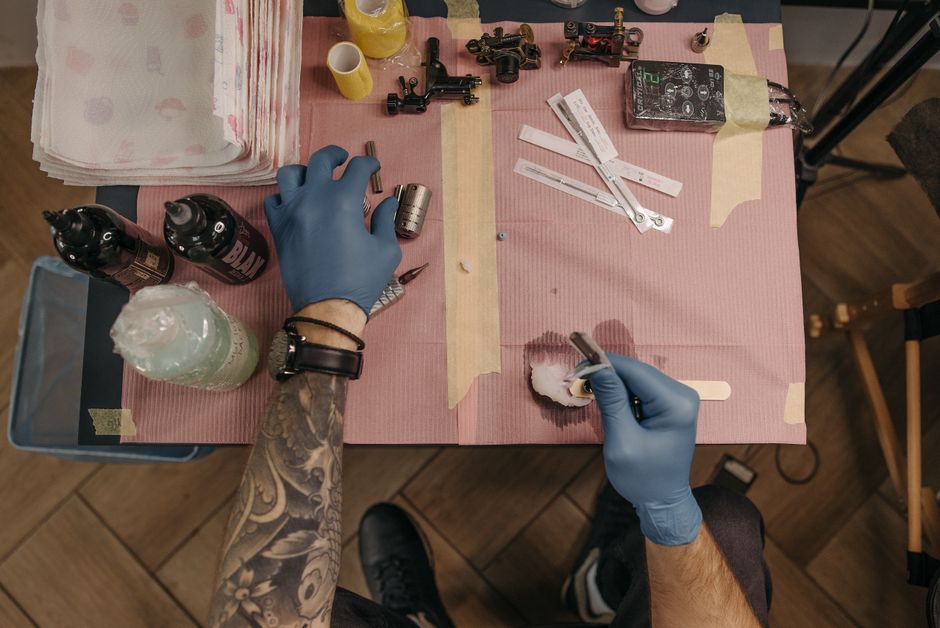
Tattoo studios sanitize between clients by removing barriers, disposing of single-use items, disinfecting all surfaces, sterilizing reusable tools in an autoclave, and rebuilding the station with fresh, sealed supplies. Here is the professional sequence:
Step 1—Glove up and clear the station: While still wearing gloves, the artist removes all used barrier film, plastic wrap, and disposable coverings from the machine, cords, chair, and work surfaces.
Step 2—Dispose of single-use items: Used needles and tubes go straight into a labeled sharps container. Ink caps, razors, gloves, and paper products go into a biohazard bag.
Step 3—Disinfect every surface: Using a hospital-grade disinfectant, the artist wipes down the chair, armrest, machine, clip cord, work tray, and any surface touched during the session, allowing proper contact time.
Step 4—Sterilize reusable equipment: Any reusable tools, like grips or tubes, are scrubbed in an ultrasonic cleaner and then run through an autoclave to reach true sterilization.
Step 5—Wash hands and re-glove: The artist removes gloves, washes hands thoroughly, and puts on a fresh pair before touching anything clean.
Step 6—Rebuild with fresh barriers: The station is re-wrapped with new barrier film, and freshly sealed, single-use supplies are opened in front of the next client.
Pro Tip: Always open sterilized and single-use packaging in front of your client. Seeing the seal break builds instant trust and shows you have nothing to hide.
What Is an Autoclave and Why Does Every Studio Need One?
An autoclave is a machine that uses high-pressure saturated steam, typically at 250°F or higher, to sterilize reusable tattoo equipment by destroying all bacteria, viruses, fungi, and heat-resistant spores. It is the only tool that achieves true sterilization.
Disinfectants reduce germs on surfaces, but sterilization eliminates them completely. That distinction matters when tools contact blood. A reputable studio runs its reusable equipment through an autoclave and often keeps sterilization logs to prove compliance.
Learning to operate and monitor an autoclave, including running spore tests, is a rite of passage for any apprentice. It is exactly the kind of hands-on skill you will not pick up from a video, which is why the right tools and knowledge matter. Our breakdown of tools every beginner tattoo artist should know covers the equipment that keeps your station professional.
Which Supplies Are Single-Use and Thrown Away?
Needles, tattoo tubes, ink caps, ink, razors, gloves, barrier film, and paper towels are all single-use items that are discarded after one client and never reused. When in doubt, throw it out.
Modern studios lean heavily on disposable, pre-sterilized supplies because they remove the risk of reuse entirely. A fresh cartridge needle comes sealed in individual packaging that is only opened at the moment of use.
Needles and cartridges: Deposited directly into a sharps container after use.
Ink and ink caps: Poured fresh for each client and discarded, never poured back into the bottle.
Gloves and razors: Changed and discarded between clients and whenever contamination is possible.
Barrier film and clip cord sleeves: Wrap high-touch equipment and are stripped off and trashed after each session.
Proper aftercare is the client's side of this equation, and it starts with a clean bandage over freshly tattooed skin. The American Academy of Dermatology tattoo care guidelines outline how to protect the healing skin once the client leaves your chair.

Who Regulates Tattoo Studio Sanitation?
Tattoo studio sanitation is regulated by federal OSHA bloodborne pathogen standards and by individual state and county health departments, which set licensing, inspection, and cleanliness requirements for studios and artists. Rules vary by state.
OSHA sets the baseline for handling blood and preventing exposure, while your state decides the specifics of licensing and inspections. Because requirements differ, knowing your local rules is essential before you ever pick up a tattoo machine.
For example, the path to licensing looks different depending on where you work. Explore our guides on how to get your tattoo license in Texas or how long a tattoo license takes in Colorado to see how sanitation training ties directly into becoming legal to work.
Where Do You Learn Proper Sanitation as an Aspiring Artist?
You learn proper sanitation through a hands-on tattoo apprenticeship, where an experienced mentor teaches you cross-contamination control, autoclave operation, and station setup before you ever tattoo a client. Real skills demand real guidance.
No online course or self-taught shortcut can replace standing beside a licensed professional who corrects your technique in real time. This is where the invisible discipline of sanitation becomes second nature, long before you build your artistic reputation.
If you are stuck in a job that drains your creative potential, this is your sign. A career in tattooing is one of the few paths that is both deeply human and largely AI-proof, as we explain in why tattoo artists are still essential. The seeds you plant today can grow into a career that no machine can replace.
Get Serious About Your Craft With Ink Different Tattoos
Ink Different Tattoos offers a Traditional Tattoo Apprenticeship that trains you in sanitation, technique, and professionalism as a college alternative for aspiring Tattoo Artists who pursue excellence. We have trained professionals since 2011.
Here is what you can expect from our Traditional Tattoo Apprenticeship. It runs 18 to 24 months across a proven four-phase structure, giving you personalized, hands-on training. You train hands-on in real tattoo studios, working alongside your Mentor. Best of all, it is built for beginners: no prior art experience needed.
A career that comes with confidence. Our tattoo apprenticeship focuses on job-ready skills, licensing support, and a guaranteed job offer at one of our tattoo studios, so you graduate knowing how to run a spotless station, protect your clients, and step into the industry as a professional.
Mentorship that pushes your brand and skills further. If you want to accelerate, our one-year, in-person Master Mentorship pairs you with celebrity and award-winning Mentors like Al Fliction, Liz Cook, Kyle Dunbar, Boneface, and Jordi Pla. It is ideal for mastering a specific style, growing your career, and building your own business.
Making tattoo training accessible for everyone. We offer Spanish-speaking locations in Denver, Orange County, NYC, Miami, San Antonio, and San Diego, because excellence should not stop at a language barrier. And with our supportive, family-like "Good Humans" culture, you never walk this path alone.
Seats in our tattoo apprenticeship are limited by design, because live, in-person mentorship cannot be mass-produced.
Ready to Become a Tattoo Artist?
A clean, confident, professional Tattoo Artist starts with the fundamentals, and it starts with a decision.
Ready to become a tattoo artist? Apply now to Ink Different's Traditional Tattoo Apprenticeship and start building an AI-proof career, with licensing support along the way. Prefer to test the waters first? Fill out our quick questionnaire to get personalized support and find out if our Traditional Tattoo Apprenticeship is right for you.
Frequently Asked Questions
How often do tattoo studios sanitize their equipment?
Tattoo studios sanitize their station between every single client, without exception. Surfaces are disinfected, single-use items are discarded, and reusable tools are sterilized in an autoclave after each session.
What is the difference between disinfecting and sterilizing?
Disinfecting reduces germs on surfaces, while sterilizing in an autoclave destroys all microorganisms, including spores. Reusable tattoo tools must be fully sterilized, not just disinfected.
Do I need prior experience to learn tattoo sanitation?
No. Ink Different Tattoos' Traditional Tattoo Apprenticeship is built for beginners and teaches sanitation, cross-contamination control, and station setup hands-on before you ever tattoo a client.
How long does the Ink Different Tattoo Apprenticeship take?
The Traditional Tattoo Apprenticeship runs 18 to 24 months across a 4-Phase structure. The exact timeline depends on how quickly you master each stage of your training.
What makes Ink Different Tattoos different from a tattoo school?
Ink Different offers live, in-person mentorship with award-winning mentors, a supportive "Good Humans" culture, and over 15 years of experience training professional tattoo artists since 2011.
Who regulates tattoo studio cleanliness?
Federal OSHA bloodborne pathogen standards set the baseline, while individual state and county health departments handle licensing, inspections, and specific sanitation requirements for studios and artists.