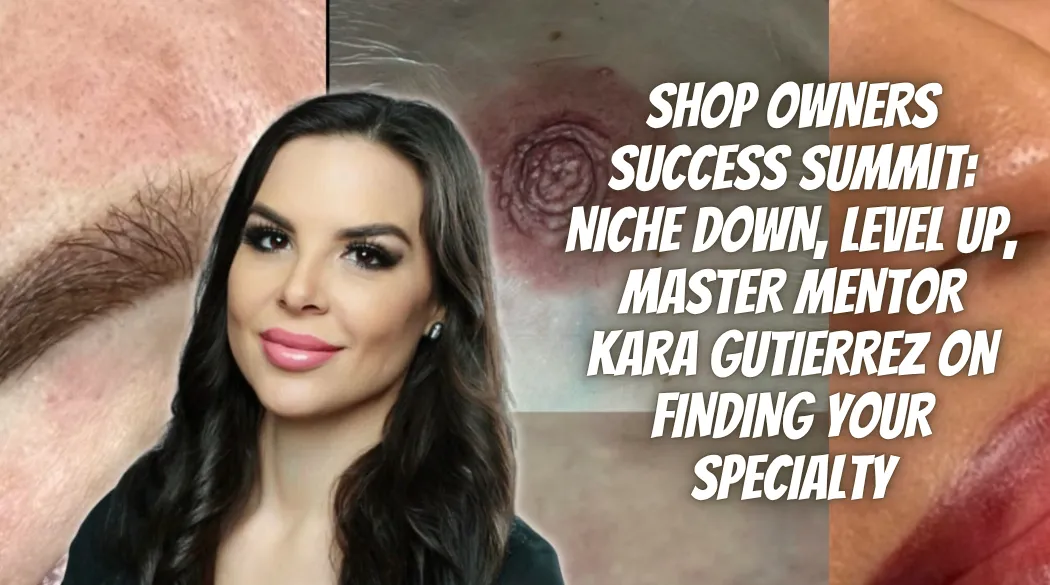
Shop Owners Success Summit: Niche Down, Level Up, Master Mentor Kara Gutierrez on Finding Your Specialty
Master Mentor Kara Gutierrez started tattooing in 2011 as a broke single mom, living with her parents and hustling seven days a week in fast-paced tattoo shops. Today, she restores areolas for clients who fly and drive in from far away to see her. She also teaches other Tattoo Artists, and she says she makes more money saying no than saying yes.
At Ink Different’s Shop Owners Success Summit, Kara shared how she found her specialty in a talk called “Niche Down, Level Up.” She also explained how any Tattoo Artist or tattoo shop owner can find theirs. Her core message: own your specialty before it owns you.
Key Takeaways
Success can become a prison: Being booked solid with no boundaries, clients you dislike, and work you don’t enjoy isn’t freedom.
Branding is emotional identity: It’s not your logo or fonts. It’s who you are, who you attract, and how you make people feel.
Three questions reveal your niche: Your favorite tattoo, your favorite client, and the tattoo you never want to do again.
Identity drives profit: Kara says most Tattoo Artists don’t have a marketing problem. They have an identity problem.
Protect your peace: Hire people who share your energy, and stop calling chaos “hustle culture.”
What does it mean to niche down as a Tattoo Artist?
Niching down means focusing on the type of tattoo work and clients that truly fit you. For Kara, it also means knowing your strengths and referring out what you can’t do best.
Kara can tattoo a lot. Her late brother taught her to learn one body part really well, like the forearm, before moving to the next. She learned the entire body that way.
She also became hyper-focused on healed results. She learned to tattoo by asking how she wanted a piece to heal. Then she stayed in the lane where she could produce the best healed results, and referred out the rest.
She points out that niches like American traditional, neo-traditional, fine line, biomech, black and gray, and realism exist for a reason. They reflect a gut feeling about what feels right to you.

Why does finding your specialty matter so much?
Finding your specialty matters because, as Kara puts it, success without boundaries can turn into a prison.
Many people dream of owning a tattoo shop. Then they realize they’ve built themselves a trap: booked solid, burned out, no boundaries, clients they dislike, and work they no longer enjoy.
Your specialty also shapes your team. Kara says Tattoo Artists with different energy and clients may not coexist well. If they don’t respect each other, there will be talk behind backs, the money won’t flow right, and the energy will feel off. Her advice is to protect your peace.
Tattooing is also a human craft, and Kara’s work shows why. As we explain in why tattoo artists are still essential, the trust between a Tattoo Artist and a client can’t be automated.
What does Master Mentor Kara Gutierrez say about finding your niche?
Kara says your niche comes from knowing who you are, then making sure your brand reflects that.
Branding is your emotional identity
Kara says branding isn’t your logo, fonts, business cards, or social media. It’s your emotional identity: who you are, who you attract, and how you make people feel.
She has fun with it. Her business card is plastic, so people sometimes chase her down thinking she dropped a credit card. At conventions, her booth has a thick tasseled curtain, her name in shiny iridescent letters, and fake candlesticks. It also keeps people from touching her things.
But she says those extras don’t matter on their own. What matters is that people feel special when they meet her.
It’s an identity problem, not a marketing problem
Kara says most Tattoo Artists think they have a marketing problem. They actually have an identity problem. Your dream clients are already looking for someone like you. The question is whether you’re willing to be that person publicly.
Her own path to a niche
Kara started in a black and gray Chicano tattoo shop. Then she moved to a punk goth tattoo shop and later an upscale tattoo shop with a feminine style. She also had permanent makeup clients, and some traditional Tattoo Artists didn’t like how much she charged for that work. Eventually, she went solo.
Then a breast cancer survivor came to her, devastated by poorly done orange nipple tattoos. Kara knew how to tattoo and understood color theory, so she fixed them. The client told her doctors, and they started referring patients to Kara.
Her reputation grew from there. She began teaching in 2017 and started a breast cancer foundation. You can read more about her areola restoration work in our article on how Master Mentor Kara Gutierrez built a career restoring areolas for breast cancer survivors.
How do you find your tattoo specialty?
Kara uses three questions to help Tattoo Artists find their identity, purpose, and ideal clients.
Question 1: What’s your favorite tattoo to do, and why?
Not the one that pays the most or the trendy one. Kara says your answer reveals what you’re naturally gifted at.
Her favorite is areola restoration. She studied to be a trauma therapist, and she understands the medical side and the emotional trauma her clients have been through. Many have never had a tattoo or shown their chest to anyone but a partner. Kara is gifted at making them feel comfortable.
Question 2: Who’s your favorite client?
Describe their personality, energy, and values. Kara says this reveals who you’re meant to serve.
Most of her clients are between 50 and 80 years old. She loves that they have no filter. They’re excited to see her, they love sharing their journeys, and they’ll laugh and swap stories with her.
Question 3: What tattoo would you never want to do again?
What drains you or feels inauthentic? Kara says this reveals the boundaries you need to set. For her, it’s repeating the same designs over and over. She now encourages clients to try something more personal.
Then build your team around it
Once you know who you are, Kara says the Tattoo Artists on your team should know who they are, too. When everyone knows themselves, you can coexist, be honest, respect each other, and flourish.
At her tattoo shop, they hold weekly meetings to review each other’s social media. They give feedback, celebrate each other’s work, and even film content for one another.

What mistakes should you avoid when niching down?
Kara shared several “lies” she says shop owners often believe:
“More services equal more money.” Kara says identity equals profitability. Get really good at what you do, and people will find you.
Underpricing out of fear. Profitable tattoo shops have boundaries, culture, consistency, and trust. Don’t undercharge because you’re scared.
Hiring people who destroy your peace. Kara says it’s never worth it.
Calling chaos “hustle culture.” Your tattoo shop doesn’t have to be chaotic to be profitable.
Saying yes to everyone. It leads to exhaustion, chaos, resentment, and confusion. Kara says some Tattoo Artists need boundaries more than marketing.
Letting others define you. Kara warns against copying what everyone else is doing online if it isn’t authentic to you.
She also has opinions on some specialties. She personally doesn’t like scar camouflage because she’s never seen it heal well, and skin can change over time. She says scalp micropigmentation tends to look better on darker skin tones. If you want either service, she recommends going to specialists with hundreds of healed results.
Safety matters in every niche. Every Tattoo Artist should follow the OSHA bloodborne pathogens standard.
Get Serious About Your Specialty With Ink Different Tattoos
Kara’s advice for anyone hoping to specialize is clear: learn how to tattoo first.
During the Q&A, an Ink Different apprentice asked how to get into restorative work without a medical background. She shared that she’s been a single mom since 16 and is starting her tattoo career at 33.
Kara said you don’t need a medical background. Unless you’re a nurse or a doctor, you’re a Tattoo Artist. Tattoo Artists deposit ink into the skin with a tattoo machine. They aren’t injecting anything, so it isn’t a medical procedure. That’s also why Kara says there’s no such thing as “medical tattooing.” There are just Tattoo Artists who understand how to work with scars and trauma.
Her advice:
Learn to tattoo first. Finding a good tattoo apprenticeship is hard, and it should be. She said Ink Different matches apprentices with the right Tattoo Artists to learn from.
Start drawing now. Learn to draw realism as soon as you can.
Learn scars over time. Kara expects Tattoo Artists to understand how scars behave after about five years of tattooing.
Listen to your Mentor. Do exactly what they tell you, when they tell you.
Ink Different has trained Tattoo Artists for 15 years. See why tattoo apprenticeships are gaining ground as a college alternative.
What You Can Expect from our Traditional Tattoo Apprenticeship?
Ink Different’s Traditional Tattoo Apprenticeship is an 18 to 24 month, four-phase tattoo apprenticeship that takes beginners to job-ready Tattoo Artists with licensing support.
Beginner-friendly: No prior art experience required.
Hands-on training: You learn in person from experienced Mentors inside a working tattoo studio.
Licensing support: Guidance through your state’s requirements, like how to get your tattoo license in Texas or how long a tattoo license takes in Colorado.
A guaranteed job offer: You’ll receive a guaranteed job offer at one of Ink Different’s tattoo studios.
This is a career that comes with confidence. You’ll finish with job-ready skills, licensing support, and a guaranteed job offer at one of Ink Different’s tattoo studios. Seats are limited, with only two apprentices per tattoo studio per Mentor.
Mentorship That Pushes Your Brand and Skills Further
Once you’ve built your foundation, Ink Different’s Master Mentorship connects you with Master Mentors, including Kara Gutierrez, Al Fliction, Liz Cook, Kyle Dunbar, Boneface, and Jordi Pla.
Kara’s own teaching has high standards. Her training runs six weeks and is for Tattoo Artists with five or more years of experience. She’ll talk with exceptional Tattoo Artists who have less, but she wants students who already know how to tattoo. She teaches with her husband, Arian Culp, MD, a double board-certified physician. Each of them stays in their own lane, sharing a goal of better outcomes for survivors.
Her training is based in Lee’s Summit, Missouri. We think of her as the best at what she does in the Midwest. Hospitals send her patients from all over.
Making Tattoo Training Accessible for Everyone
Ink Different offers Spanish-speaking locations in Denver, Orange County, NYC, Miami, San Antonio, and San Diego. Ink Different’s “Good Humans” culture means you’re never doing this alone.
Kara believes in access, too. She says the tattoo industry is finally moving away from gatekeeping, and that a tattoo shop should be a heart and a soul, not just a business.
Ready to Become a Tattoo Artist?
Kara Gutierrez went from a hustling single mom in fast-paced tattoo shops to a specialist clients travel to see. She got there by knowing who she is, setting boundaries, and saying no to work that didn’t fit.
Her advice for finding new clients in a specialty like hers is to show healed results. She recommends visiting plastic surgeons, private practices, cancer centers, and nonprofits in person with your portfolio. She’s also reached clients through top surgery communities and people who’ve had weight loss surgery. She suggests keeping a separate Instagram for restoration work, since many of those clients aren’t into tattoos. Her website, inthespot.ink, has separate landing pages for each service.
As she puts it, once you find your people, they’ll market for you, defend you, and stay loyal.
For tattoo shop owners: Explore Ink Different’s shop owner training to build a team, culture, and brand around who you are.
For aspiring Tattoo Artists: Apply now to Ink Different’s Traditional Tattoo Apprenticeship and start building an AI-proof career with licensing support and a guaranteed job offer. Prefer to test the waters first? Fill out our quick questionnaire to see if it’s right for you.
Follow Kara on Instagram at @karaspotonbeauty, or visit her website at inthespot.ink.
Frequently Asked Questions
What are Kara Gutierrez’s three questions for finding your niche?
What’s your favorite tattoo and why? Who’s your favorite client? What tattoo would you never want to do again?
Do I need a medical background to do areola restoration?
No. Kara says Tattoo Artists don’t need a medical background. You need strong tattooing skills and experience tattooing over scars.
What does Kara mean by “branding is emotional identity”?
Your brand isn’t your logo or business cards. It’s who you are, who you attract, and how you make people feel.
How long does the Traditional Tattoo Apprenticeship take?
Ink Different’s Traditional Tattoo Apprenticeship takes 18 to 24 months across four phases, with licensing support and a guaranteed job offer.
Who can train with Kara Gutierrez?
Kara’s training is for Tattoo Artists with five or more years of experience, though she’ll talk with exceptional Tattoo Artists who have less.
Where is Kara Gutierrez located?
Kara works and teaches in Lee’s Summit, Missouri. Follow her on Instagram at @karaspotonbeauty.