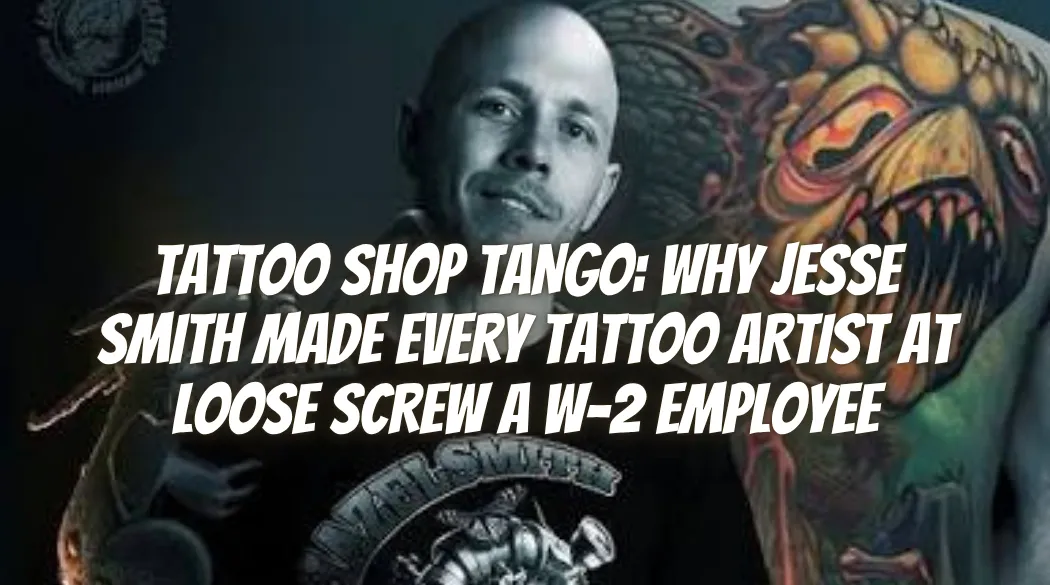
Tattoo Shop Tango: Why Jesse Smith Made Every Tattoo Artist at Loose Screw a W-2 Employee
Jesse Smith has been tattooing for almost 30 years. He owns Loose Screw Tattoo in Richmond, Virginia, and runs the Richmond Tattoo and Arts Convention. It’s recognized by Guinness World Records as the longest-running tattoo convention in the world. He’s also known for making a choice few tattoo shop owners make: every Tattoo Artist at Loose Screw is a W-2 employee with access to medical and dental coverage and paid vacation. When he made the switch, about six people left. In the first episode of Tattoo Shop Tango, presented by Ink Different, Jesse sat down with us and co-host Chico Cortez to explain why he did it and what it really takes to make it work.
Key Takeaways
The shift: Jesse moved all 12 of his Tattoo Artists from 1099 contractors to W-2 employees, along with seven or eight admin staff.
The benefits: Medical, dental, paid vacation, supplies, and cleaning, so Tattoo Artists can focus on tattooing and art.
How it’s funded: Participating Tattoo Artists put a share of their cut toward benefits, currently 8%, recalculated each year.
The trade-off: Loyalty is high, with most of his team there more than five years. But comfort can lower the drive to work more hours.
His priority: He’ll take a Tattoo Artist with a great attitude over raw talent any day.
What is the W-2 shift Jesse Smith made at Loose Screw?
Jesse Smith reclassified every Tattoo Artist at Loose Screw from a 1099 independent contractor to a W-2 employee.
When he first opened Loose Screw, he ran everyone as 1099 contractors, the way the tattoo shops he came from did. He didn’t know the difference between the two at first.
Then he learned something important. To offer health insurance in Virginia, he needed his team on payroll as employees. As he studied what it takes to run a fully legitimate business, he tightened up licensing, taxes, and everything else that could fall through the cracks. As the owner, he knew he’d pay the price if anything did.
When he was ready, he gave his team six months’ notice. He also gave a few Tattoo Artists the option to stay 1099. In the end, about six people left. It was painful, but Jesse knew he was building the tattoo shop he wanted.
What is the difference between a W-2 employee and a 1099 contractor in a Tattoo Shop?
A W-2 employee is on the tattoo shop’s payroll. The employer withholds taxes and can offer benefits. A 1099 contractor is self-employed and handles their own taxes and expenses.
W-2 employee: The employer withholds taxes and can provide benefits like health insurance and paid time off. The business also takes on more structure and responsibility.
1099 contractor: The Tattoo Artist manages their own taxes and expenses, typically with more freedom over when and how they work.
The IRS explains how businesses determine whether someone is an employee or a contractor. Tattoo shop owners should talk with a tax professional before changing how their team is classified.
As Jesse points out, most tattoo shops in Richmond run their Tattoo Artists as 1099 contractors. He chose to offer something different.
Why did Jesse Smith choose W-2 employment for his artists?
Jesse chose W-2 employment because he wanted a tattoo shop where Tattoo Artists could focus on tattooing and art, not the business side.
He grew up with benefits
Jesse’s father was in the Army, so Jesse grew up with free medical and dental care. After high school, he joined the Army himself from 1996 to 1999, which is where he started tattooing. Having that coverage always made sense to him. He believes access to health care is one of the most valuable things a workplace can offer.
He built the tattoo shop he wished he’d worked in
Before opening Loose Screw, Jesse tattooed at tattoo shops in England, the Florida panhandle, Germany, and around Richmond. At each one, he had ideas for how to make it better. After about 14 years of tattooing, he finally felt ready to open his own.
Today, Loose Screw offers medical and dental coverage, paid vacation, supply ordering, and most of the cleaning. Not every Tattoo Artist opts into benefits, and paychecks are adjusted based on what each person chooses.
He wanted loyalty and consistency
Jesse once heard that Tattoo Artists stay at a tattoo shop for three to five years on average. Most of his team has been with him longer than five. He believes the benefits are a big reason why. He may make less money from each Tattoo Artist, but he gets loyalty, consistency, and a crew he trusts.
How the benefits are funded
Here’s an example. If a Tattoo Artist’s cut is 60%, they can put a percentage of their paycheck toward the benefits package. That rate started at 5% and is currently 8%.
Each year, Jesse recalculates it based on a few variables: what the benefits cost, how many Tattoo Artists participate, and how much revenue they bring in. Health insurance costs went up sharply this year. If participating Tattoo Artists bring in more revenue, the percentage can go down.
The honest trade-offs
Jesse is open about the downside. When a tattoo shop gets very comfortable, he says, people aren’t as hungry. Every Tattoo Artist at Loose Screw is booked as much as they want to be. Some choose to tattoo two or three hours a day.
He’s tracked billable hours for about 10 years. That means time actually tattooing, not setup or consultations. The average Tattoo Artist at his tattoo shop tattoos about 10 hours a week. A hungry new Tattoo Artist might hit 25 at most. Other tattoo shop owners he’s talked to see similar numbers.
He tried an incentive bracket that raised a Tattoo Artist’s percentage for each extra billable hour per week. It was clunky and time-consuming, and it didn’t change how much most people worked.
More recently, he’s let a few Tattoo Artists work as 1099 contractors. It only works for those who can handle the business side, like answering emails quickly and providing strong customer service.
Pro Tip: When your team asks for raises, Jesse breaks down the math. If a Tattoo Artist takes a higher percentage, it comes from the business or from admin staff. The only way to earn more without taking from anyone else is to raise prices.
What does this trend mean for you as an aspiring Tattoo Artist?
Jesse’s approach isn’t the norm yet. But it shows that some tattoo shop owners are investing heavily in Tattoo Artists who are professional, reliable, and easy to work with.
Jesse was clear about what he values. Some Tattoo Artists are amazing but show up late and act like everything revolves around them. Others aren’t as talented yet but work hard, show up on time, stay clean, and have good attitudes. He’ll take the second kind any day.
He also believes one “A player” is worth more than 10 “B players.” When he finds one, he does everything he can to keep them.
Chico added his own take. You can teach someone to tattoo, but you can’t teach them to be a good person.
Jesse also wants a tattoo shop that stays human. He doesn’t want it run like a frat house, but he doesn’t want it too corporate either. He’s not interested in building something “scalable.” He wants a well-run, professional mom-and-pop tattoo shop where he still knows everyone’s name.
How do you prepare for a professional Tattoo Studio career?
You prepare by building strong skills, professional habits, and the attitude tattoo shop owners like Jesse look for.
Step 1: Commit to real training. A structured tattoo apprenticeship gives you a Mentor and a clear path.
Step 2: Master the fundamentals. Drawing, line work, and tattoo machine handling come before anything touches skin.
Step 3: Learn safety standards. Study the OSHA bloodborne pathogens standard to protect every client.
Step 4: Build professional habits. Show up on time, stay clean, and respond to clients quickly. Loose Screw promises a reply to every email within 48 hours.
Step 5: Develop your own creative voice. Around 2009, Jesse felt stuck drawing the same rabbits and squirrels. So he invented Carkayous, a fictional continent about 1,000 miles off the coast of Ecuador with its own creatures. Every character got a name, a backstory, friends, and enemies. His first Carkayous piece was a full bodysuit that took about 300 hours. Now clients collect his characters. He even collaborated with Tattoo Artists like Frank La Natra, so their characters could be friends or rivals.
Step 6: Avoid burnout. Jesse’s “rotate your muscles” method came from the Army. A drill sergeant once had him do flutter kicks for 20 minutes, and he survived by switching muscle groups. He applies the same idea to tattooing, running his tattoo shop, running a convention, and being a dad. When one gets tiring, he switches to another.
Step 7: Get licensed. Meet your state’s requirements so you can work professionally.
Before you start, read about the mistakes aspiring tattoo apprentices should avoid and the tools every beginner tattoo artist should know.
What you can expect from our Traditional Tattoo Apprenticeship
The Traditional Tattoo Apprenticeship is an 18 to 24 month, four-phase tattoo apprenticeship that takes beginners to job-ready Tattoo Artists with licensing support.
Ink Different has trained Tattoo Artists for 15 years through hands-on mentorship. Here’s what you can expect:
Beginner-friendly: No prior art experience required.
Hands-on training: You learn in person from experienced Mentors inside a working tattoo studio.
Licensing support: Guidance through your state’s requirements.
A guaranteed job offer: You’ll receive a guaranteed job offer at one of Ink Different’s tattoo studios.
Seats are limited, with only two apprentices per tattoo studio per Mentor.
A career that comes with confidence
This is a career that comes with confidence. You’ll finish with job-ready skills, licensing support, and a guaranteed job offer at one of Ink Different’s tattoo studios. You’ll also have the professional habits that owners like Jesse value most.
Mentorship that pushes your brand and skills further
Once you’ve built your foundation, you can keep growing with Ink Different’s Master Mentors, including Al Fliction, Liz Cook, Kyle Dunbar, Boneface, and Jordi Pla.
Jesse’s Carkayous characters show how a signature style can turn clients into collectors. Learning from Master Mentors can help you develop your own voice.
Making tattoo training accessible for everyone
Ink Different offers Spanish-speaking locations in Denver, Orange County, NYC, Miami, San Antonio, and San Diego, so language is never a barrier to your tattoo career.
Jesse shares that spirit of access. At the Richmond Tattoo and Arts Convention, he gives free tickets to senior citizens, students, active duty military, veterans, and Virginia-licensed Tattoo Artists. His goal is to eventually offer free entry to all Tattoo Artists once there’s a way to verify them.
The convention’s roots run deep. It began in 1988 as a gathering of Tattoo Artists at the same hotel where it’s still held today. Over the years, it passed from Grandpa Groovy, “Crazy” Ace Daniels, and Billy Eason to Nate Drew. Then Jesse and Kenny Brown took over in 2016. Kenny passed away in a motorcycle accident in 2022, and Jesse has run it ever since. Paul Rogers even did his last tattoo there in 1989.
Jesse compares running a convention to the board game Mouse Trap. You spend all year building it, then let the marble go and hope it works. This year’s convention runs October 23 to 25 in Richmond, Virginia.
Ready to Become a Tattoo Artist?
Jesse Smith built Loose Screw around one idea: Tattoo Artists should be able to focus on their art. Making everyone a W-2 employee cost him people at first. It also gave him a loyal, long-term team he trusts.
For tattoo shop owners: Explore Ink Different’s shop owner training to build the systems, culture, and team your tattoo shop needs.
For aspiring Tattoo Artists: Apply now to Ink Different's Traditional Tattoo Apprenticeship and start building an AI-proof career with licensing support along the way. Prefer a lighter first step? Fill out our quick questionnaire to see if the Traditional Tattoo Apprenticeship is right for you.
To get tattooed by Jesse, fill out the submission form at jessesmithtattoos.com, where he also offers portfolio reviews, shop consulting, and free educational resources. Follow him on Instagram at @jessesmithtattoos, and follow Chico at @m4l_chico.
Frequently Asked Questions
Why did Jesse Smith make his Tattoo Artists W-2 employees?
He wanted to offer health insurance and other benefits so Tattoo Artists could focus on tattooing and art. In Virginia, that meant putting his team on payroll.
How does Loose Screw fund its benefits package?
Participating Tattoo Artists put a percentage of their cut toward benefits, currently 8%. Jesse recalculates it each year based on costs, participation, and revenue.
How many hours does the average Tattoo Artist tattoo per week?
At Loose Screw, Jesse’s tracking shows about 10 billable hours a week on average. He says other tattoo shop owners he’s spoken with see similar numbers.
How long does the Traditional Tattoo Apprenticeship take?
The Traditional Tattoo Apprenticeship takes 18 to 24 months across four phases, with licensing support and a guaranteed job offer.
When is the Richmond Tattoo and Arts Convention?
This year, it runs October 23 to 25 in Richmond, Virginia. Free tickets are available for seniors, students, active duty military, veterans, and Virginia-licensed Tattoo Artists.
Does Ink Different offer training for tattoo shop owners?
Yes. Ink Different offers shop owner training for leadership, operations, and team building.