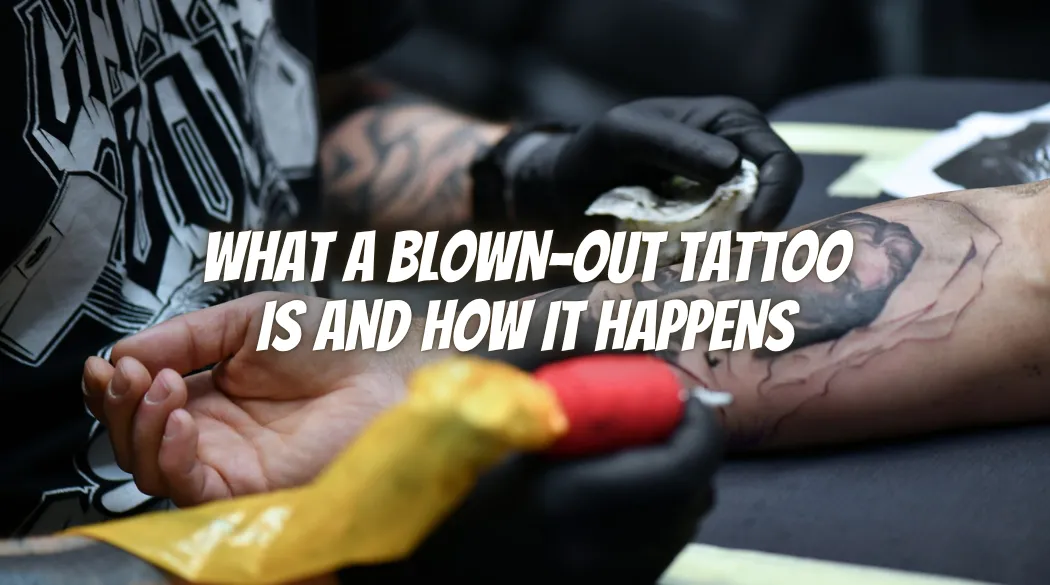
What a Blown-Out Tattoo Is and How It Happens
You spend weeks planning the perfect design. You sit through the session, you heal it up, and then you notice something wrong: the crisp lines you were promised now look like ink bleeding into a paper towel. A blown-out tattoo happens when tattoo ink is deposited too deep into the skin, causing it to spread beneath the surface and create a blurry, smudged, or shadowed appearance. Understanding why this happens is the first step toward never letting it happen on your work.
At Ink Different Tattoos, we teach aspiring Tattoo Artists the exact depth control, machine handling, and skin-reading skills that separate clean work from career-ending blowouts. Because the truth is simple: a blowout is not bad luck. It is a lack of training showing up on someone's body forever.
Key Takeaways
Definition: A blown-out tattoo happens when ink is placed too deep and spreads into surrounding tissue.
Cause: Blowouts result from improper needle depth, angle, pressure, or stretching, not client behavior.
Prevention: Proper depth control, taut skin, and correct machine handling prevent nearly all blowouts.
Fix options: Cover-ups and laser removal can help, but prevention through skilled training is best.
Bottom line: Blowouts are a skill problem, which means the right hands-on mentorship eliminates them.
What Is a Blown-Out Tattoo?
A blown-out tattoo is one where ink migrates beyond the intended lines, creating a blurred, hazy, or bruised look because pigment is deposited into the wrong layer of skin. Instead of sitting cleanly in the dermis, the ink leaks into the fatty tissue below or spreads sideways.
Think of it like planting a seed. Drop it at the right depth in good soil and it grows exactly where you want. Bury it too deep or scatter it carelessly, and it spreads into places you never intended. Skin works the same way. The dermis is the sweet spot, roughly 1 to 2 millimeters down, where ink stays put and stays sharp.
When that depth is missed, the pigment disperses. What should have been a razor-thin line becomes a soft gray smear that no amount of aftercare can undo.

How Does a Tattoo Get Blown Out?
A tattoo gets blown out when the needle penetrates past the dermis into the subcutaneous fat layer, allowing ink to disperse through loose tissue instead of holding its shape in the skin. It usually shows up during healing, when the blur becomes obvious.
The human skin has three main layers: the epidermis on top, the dermis in the middle, and the subcutaneous fat below. Ink belongs in the dermis. Go too shallow, and the tattoo fades or falls out as the epidermis regenerates. Go too deep, and you get the dreaded blowout.
According to the American Academy of Dermatology tattoo care guidelines, tattoo ink is meant to be locked into the dermal layer where it remains stable. When artists misjudge that layer, the body cannot contain the pigment, and it drifts.
What Causes a Blowout?
Blowouts are caused by improper needle depth, incorrect needle angle, excessive pressure, poor skin stretching, or working on thin-skinned areas without adjusting technique. Nearly every cause traces back to the artist's hand, not the client.
Here are the most common culprits behind a blown-out tattoo:
Going too deep: The number one cause. Pushing the needle past the dermis lets ink flood the fat layer.
Wrong needle angle: Holding the machine at a shallow or dragging angle pushes ink sideways under the skin.
Too much pressure: Leaning hard on the machine forces the needle deeper than intended.
Loose skin: Failing to stretch the skin taut lets it fold and pucker, scattering the ink.
Thin-skinned areas: Wrists, feet, fingers, and inner arms have very little dermis, so they blow out easily without adjusted technique.
Pro Tip: Blowouts are almost never the client's fault. If you are training to become a Tattoo Artist, own your depth control from day one. It is the single most important habit you will build.
How Do You Know If Your Tattoo Is Blown Out?
You can identify a blown-out tattoo by a hazy gray or blue shadow spreading beyond the original lines, blurred edges, or ink that looks like it bled into the skin, typically visible after healing. A little redness during healing is normal; a permanent smudge is not.
During the first week or two, some blurring and puffiness is expected as the skin recovers. The problem is real when that fuzziness sticks around after the tattoo is fully healed, usually around four to six weeks in.
Signs to watch for:
A grayish or bluish halo around the design
Lines that look fatter or fuzzier than the original stencil
Fine details that have merged together into a blob
A shadowy tail spreading off the edges of the tattoo
If you are studying to work professionally, learning to spot the early warning signs mid-session is a skill in itself. This is one of many things new artists overlook, which is why we cover the mistakes aspiring tattoo apprentices should avoid in real, hands-on training.
How Can You Prevent a Blown-Out Tattoo?
You prevent blowouts by mastering consistent needle depth, keeping the skin stretched tight, controlling your angle and pressure, and adjusting your technique for delicate areas of the body. Prevention is entirely about technique, which means it is entirely learnable.
Here is a simple step-by-step approach every apprentice should burn into muscle memory:
Read the skin first. Assess thickness, location, and elasticity before your needle ever touches down.
Stretch it taut. Use your free hand to pull the skin flat and firm so the needle enters cleanly.
Dial in your depth. Aim for the dermis, roughly 1 to 2 millimeters, and keep it consistent across every pass.
Control your angle. Keep the machine as close to perpendicular as the design allows to avoid dragging ink sideways.
Ease your pressure. Let the machine do the work. Heavy hands push needles too deep.
Adjust for thin skin. On wrists, fingers, and feet, lighten up and slow down.
These fundamentals are also tied to knowing your equipment inside and out. Understanding your setup matters, which is why we walk beginners through the tools every beginner tattoo artist should know. And because you are working on human skin, following OSHA bloodborne pathogen standards is non-negotiable in every session.
Can a Blown-Out Tattoo Be Fixed?
A blown-out tattoo can often be improved through a skilled cover-up, strategic rework, or laser removal, but it can rarely be fully erased without professional intervention. The best fix is always preventing it in the first place.
Depending on the severity, here are the main options:
Cover-up: A larger, darker design can absorb and disguise the blurred area.
Rework: A skilled artist can sometimes tighten lines or add shading to camouflage minor blowouts.
Laser removal: Repeated laser sessions can lighten or remove the migrated ink, though this takes time and money.
None of these are cheap, quick, or guaranteed. That is exactly why depth control is one of the first things we drill into every Tattoo Apprentice. The pain of fixing a blowout is far greater than the effort of learning to avoid one.
Why Does This Come Down to Training?
Blowouts come down to training because they are caused by technique errors that live, in-person mentorship corrects long before an apprentice ever touches a paying client. No online video can watch your hand and correct your depth in real time.
This is the core problem with self-teaching. You can watch a thousand tutorials and still have no idea whether your needle is sitting in the dermis or plowing into the fat. Skin feedback is tactile, and it has to be learned in person, under the eyes of a Mentor who has done it thousands of times.
That hands-on correction is what makes tattooing an AI-proof career. A machine cannot feel the resistance of skin or read a client's body. If you have been sitting in a job that drains you while your creative potential collects dust, this is the craft that rewards real skill. Learn more about why tattoo artists are still essential in a world racing toward automation.
Get Serious About Your Craft With Become A Tattoo Artist
Ink Different Tattoos has spent 15 years training professional Tattoo Artists to produce clean, blowout-free work through our nationwide tattoo apprenticeship, a serious college alternative for people who want a real creative career. Since 2011, we have built our reputation on excellence, not shortcuts.
Our Traditional Tattoo Apprenticeship runs 18 to 24 months across four structured phases. Here is what you can expect:
Personalized hands-on training so a Mentor can correct your depth, angle, and pressure in real time
Start remote, finish in our Tattoo Studios for a smooth ramp into live work
Built for beginners with no prior art experience required
Licensing support and job-ready skills so you finish prepared to work professionally
A career that comes with confidence starts with fundamentals done right. When you understand skin depth, machine control, and safety from the ground up, you walk into a studio knowing your lines will hold. For those wondering about the bigger picture, tattooing is a growing field for skilled craft artists, as tracked by the Bureau of Labor Statistics on craft and fine artists.
Want to push even further? Our Master Mentorship is a one-year in-person program that connects beginner and experienced artists with celebrity and award-winning Mentors like Al Fliction, Liz Cook, Kyle Dunbar, Boneface, and Jordi Pla. It is built for mastering a specific style, exploding your career, and owning your own business.
We also believe in making tattoo training accessible for everyone. That is why we offer Spanish-speaking locations in Denver, Orange County, NYC, Miami, San Antonio, and San Diego. Wherever you are, our family-like "Good Humans" culture makes sure you never train alone.
Ready to Become a Tattoo Artist?
Every clean line starts with a decision to train the right way. A blown-out tattoo is not fate. It is a fixable skill gap, and closing that gap is exactly what we do.
Ready to become a Tattoo Artist? Apply now to Ink Different's Traditional Tattoo Apprenticeship and start building an AI-proof career with licensing support along the way. Not sure yet? Fill out our quick questionnaire to get personalized support and find out if our tattoo apprenticeship is right for you.
Frequently Asked Questions
What is a blown-out tattoo?
A blown-out tattoo is one where ink was placed too deep and spread beyond the intended lines, creating a blurry, gray, or shadowed appearance that becomes permanent after healing.
Is a blown-out tattoo the client's fault?
No. Blowouts are almost always caused by artist technique errors such as improper depth, angle, pressure, or failing to stretch the skin, not by anything the client did.
How long before you can tell if a tattoo is blown out?
Some blurring during the first two weeks is normal healing. A true blowout is confirmed once the tattoo fully heals, usually around four to six weeks, and the haze remains.
Can a blown-out tattoo be fixed?
Sometimes. Skilled cover-ups, reworks, and laser removal can improve a blowout, but full correction is difficult and costly. Preventing it through proper training is always the better route.
What makes Ink Different Tattoos different from learning online?
Ink Different offers live, in-person mentorship where Mentors correct your needle depth and technique in real time. That hands-on feedback is impossible to get from videos and prevents blowouts.
Do I need art experience to start a tattoo apprenticeship?
No. Ink Different's Traditional Tattoo Apprenticeship is built for beginners with no prior art experience and teaches fundamentals, safety, and machine control from the very first phase.