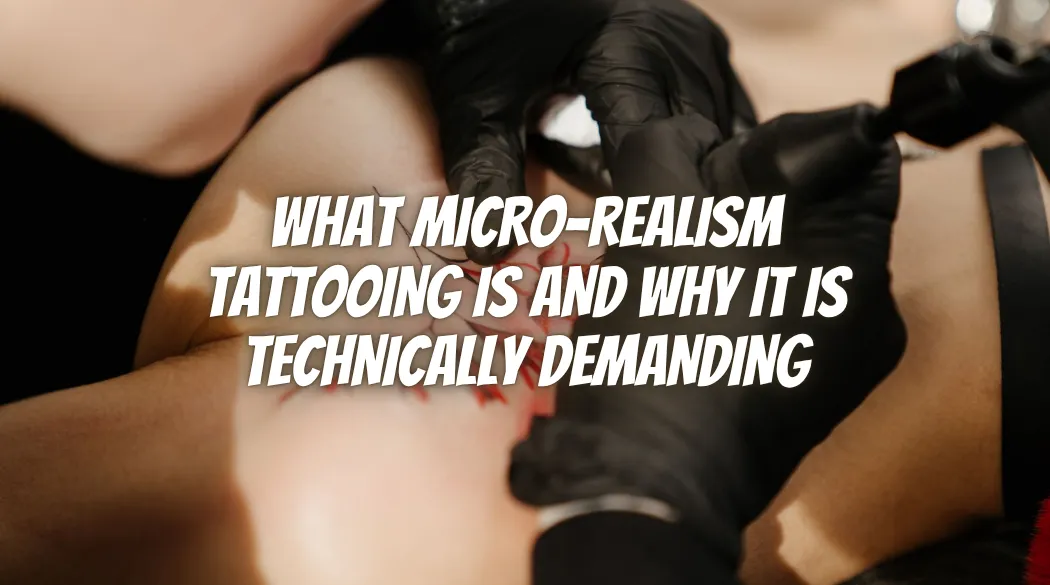
What Micro-Realism Tattooing Is and Why It Is Technically Demanding
Micro-realism tattooing is a precision-focused tattoo style that recreates lifelike, photographic images at a very small scale, often coin-sized or smaller. It demands exacting line control, advanced shading, and intricate detail work within a tightly confined area of skin. At Ink Different Tattoos, we have spent 15 years training aspiring Tattoo Artists, and micro-realism is one of the most rewarding and challenging styles you can build toward. This guide explains what makes it so demanding and how structured training prepares you for it.
Key Takeaways
Definition: Micro-realism recreates photorealistic images at a small scale, often coin-sized or smaller, with the same depth as larger work.
Difficulty: Tiny canvases magnify every error. One shaky line or over-saturated shadow can collapse the illusion and age poorly.
Skills needed: Steady hand control, advanced value mapping, precise needle selection, and deep knowledge of how ink settles in skin.
Path: A structured tattoo apprenticeship (18 to 24 months) builds drawing, safety, and machine control before you attempt fine detail work.
Career advantage: Hand craftsmanship is AI-proof. Clients will always need human judgment, skin reading, and client connection that machines cannot provide.
What is micro-realism tattooing?
Micro-realism tattooing is a style that compresses lifelike, photographic detail (faces, animals, flowers, objects) into a very small design, often no larger than a coin or a few inches, while keeping the same depth of shadow, texture, and dimension as larger realism pieces.
Where traditional realism may cover a forearm or a full back, micro-realism packs the same depth into a fraction of that canvas. The result reads as photographic from a short distance, which is why clients love it and why it is so hard to execute.
This style sits inside the broader realism family but behaves differently. Every needle pass counts more, every value transition is tighter, and the skin becomes your adversary when you try to fit too much information into too little space. Healing is critical. In micro-realism, even a small amount of ink spread can destroy the illusion.

Why is micro-realism so technically demanding?
Micro-realism is technically demanding because a tiny canvas magnifies every flaw. One shaky line or over-saturated shadow can collapse the illusion of realism, and the detail can soften as the tattoo heals and ages.
Living skin is not paper. It stretches, and ink can spread. If ink is placed too deep, it can blow out beyond the lines, and all tattoos soften over time. On a large piece, a fraction of a millimeter of spread disappears into the design. On a micro piece, the same spread can blur an eye or a petal into a smudge. You are working on a canvas that moves, heals unpredictably, and ages differently depending on body placement and aftercare.
Here is what makes the craft unforgiving:
No margin for error: Details are extremely small, so a single misplaced dot or tremor shows.
Healing dynamics: A piece must still look sharp years later, not just on day one. Poor saturation or ink spread can erase detail as skin ages.
Value control: You manage light and shadow with very fine precision, reading skin tone and adjusting needle depth constantly.
Restraint as skill: Over-packed ink is the enemy. Knowing when to stop is as important as knowing when to go deeper.
Understanding how ink and skin interact is foundational. Following sanitation and cross-contamination standards, like the OSHA bloodborne pathogen standards, prevents infection and protects you and your clients. Clients also need solid healing guidance, which is why reviewing resources like the American Academy of Dermatology tattoo care guidelines matters as much as your artwork. Proper aftercare is what separates a sharp, lasting micro-realism piece from a blurry disappointment six months in.
What skills do you need to master micro-realism?
To master micro-realism you need rock-steady hand control, an advanced grasp of value and contrast, precise needle and machine selection, and the patience to work methodically within a small area without rushing or over-saturating.
None of these appear overnight. They are built through repetition under the eye of a Mentor who has walked the path before you. The core competencies include:
Drawing fundamentals: You cannot tattoo what you cannot draw. Value studies, realism practice, and reference work come first—this is where your foundation lives.
Machine handling: Knowing your tattoo machine, needle groupings (liners, shaders, packing needles), and how fine liners behave under different settings and pressures.
Skin reading: Understanding placement, natural stretch, bone structure, and how each body area holds detail differently as it ages and moves.
Composition and restraint: Deciding what detail to keep and what to simplify so the piece reads clearly and ages gracefully. Less is often more.
If you are starting with no formal art background, do not panic. A structured tattoo apprenticeship gives you accountability, feedback, and supervised practice on real clients. The Bureau of Labor Statistics tracks craft and fine artists as a recognized field.
Pro Tip: Before investing in fine-liner work, get comfortable with the basics. Our guide to the tools every beginner tattoo artist should know is a smart first read. You will learn which machines, needles, and supplies actually matter for learning the craft.
How do you learn micro-realism step by step?
You learn micro-realism in structured stages: master drawing and value mapping on paper, build machine control on practice skin, develop safe, sanitized technique, gradually shrink your scale, then advance to fine detail on live clients under a Mentor’s supervision. Here is the progression we teach at Ink Different.
Step 1: Build your drawing foundation. Study light, shadow, and photorealism on paper for weeks. Train your eye to map values before a needle ever touches skin. This is where your visual language forms.
Step 2: Learn safety and sanitation protocols. Master cross-contamination control, setup, sterilization, and legal compliance so you can work professionally, legally, and safely.
Step 3: Develop machine control and hand steadiness. Practice consistent lines and smooth shading on synthetic skin until your hand stops fighting you and precision becomes automatic.
Step 4: Progressively shrink your scale. Move from larger realism designs to increasingly smaller pieces, learning how detail behaves as it compresses and how ink settles differently.
Step 5: Apply live work under direct Mentor supervision. Tattoo real clients with a Mentor guiding each decision, observing how your work heals, and refining technique based on real outcomes.
Rushing these steps is the fastest way to frustration. Micro-realism punishes impatience, and skipping foundations can leave you unlearning bad habits later. Our four-phase structure builds your skills in order. Every phase prepares you for the next.

What mistakes hold aspiring micro-realism artists back?
The biggest mistakes are chasing advanced detail before mastering fundamentals, over-saturating small areas with ink, and trying to learn in isolation without expert feedback and accountability.
We see talented people stall because they skipped the foundation and tried to copy an advanced artist’s finished work without the practice underneath it. Learning only from online tutorials with a cheap machine often produces blurry results.
For a fuller rundown, read our breakdown of the mistakes aspiring tattoo apprentices should avoid.
How does a tattoo apprenticeship build these skills?
A structured tattoo apprenticeship builds micro-realism skills through sequenced, hands-on training that takes you from drawing fundamentals to live client work under a licensed Mentor’s direct supervision, typically over 18 to 24 months.
This is where Ink Different Tattoos steps in as your guide. Our Traditional Tattoo Apprenticeship is a serious college alternative for people who want to pursue excellence in the craft, not a weekend crash course.
Here is what you can expect from our Traditional Tattoo Apprenticeship:
Length and structure: 18 to 24 months across a proven four-phase structure with clear progression.
Hands-on studio training: Learn in working tattoo studios under direct Mentor supervision.
Beginner-friendly foundation: No prior art experience required. We teach you from the ground up.
Career outcome: Licensing support, job-ready skills, and a guaranteed job offer at one of our tattoo studios.
Hand craftsmanship is also an AI-proof career. A machine cannot read living skin, adapt to a client’s story, or handle a needle with human judgment. If you have wondered whether this craft has a future, our piece on why tattoo artists are still essential explains why.
Beyond the technical, you join a family. Our “Good Humans” culture means you are never grinding alone. You learn alongside peers and Mentors who want you to succeed. If you are weighing this against a traditional degree, see why tattoo apprenticeships are gaining ground as a solid alternative to college.
How can Master Mentorship push your style further?
Ink Different’s Master Mentorship is a one-year, in-person training track where you learn directly from celebrity and award-winning Mentors to master a specific style like micro-realism and grow your career and reputation.
If you already have some tattoo experience, or you finish your apprenticeship ready to specialize, this is your next step. You train alongside names like Al Fliction, Liz Cook, Kyle Dunbar, Boneface, and Jordi Pla, artists who have built reputations on technical excellence and distinctive style.
The Master Mentorship is built for intensive skill development, style mastery, and business ownership. For a niche as demanding as micro-realism, learning directly from someone at the top of the craft lets you see their process and problem-solving up close.
Note: Once your skills are growing, your brand has to grow too. Start early with our guide to platforms to help tattoo artists build their brand.
Where can you train if you speak Spanish?
Ink Different operates nationwide, with the Traditional Tattoo Apprenticeship available in 60+ locations, including Spanish-speaking locations in Denver, Orange County, NYC, Miami, San Antonio, and San Diego, making professional training and mentorship accessible regardless of primary language.
Language should never stand between you and your calling. Our Spanish-speaking locations deliver the same hands-on mentorship and four-phase path, so you can learn a demanding craft like micro-realism in the language you think and create in.
Ready to Become a Tattoo Artist?
Micro-realism is hard, and that is part of what makes it worth learning. Seats in our tattoo apprenticeship are limited, because real, live mentorship cannot be mass-produced.
Ready to become a Tattoo Artist? Apply now to Ink Different's Traditional Tattoo Apprenticeship and start building an AI-proof career with licensing support, real mentorship, and a clear path to mastery. Or fill out our quick questionnaire to get personalized support and find out if the Traditional Tattoo Apprenticeship is right for you and your goals.

Frequently Asked Questions
What exactly is micro-realism tattooing?
Micro-realism is a tattoo style that recreates lifelike, photographic images at a very small scale, often coin-sized or smaller, using precise lines, advanced shading, and intricate detail work within a confined area of skin.
Why is micro-realism harder than other tattoo styles?
Micro-realism is harder because the tiny canvas magnifies every error. Ink spread, shaky lines, or over-saturation can blur detail and break the realistic illusion as the tattoo heals and ages.
Do I need art experience to learn micro-realism?
No. Ink Different’s Traditional Tattoo Apprenticeship is built for beginners and teaches drawing fundamentals from day one, so you build the foundation before advancing to fine detail work like micro-realism.
How long does the Traditional Tattoo Apprenticeship take?
The Traditional Tattoo Apprenticeship takes 18 to 24 months across a proven four-phase structure of hands-on training in tattoo studios, with licensing support.
Is a tattoo career safe from AI and automation?
Hand craftsmanship like micro-realism is AI-proof because it requires reading living skin, human judgment, artistic vision, and client connection that machines cannot replicate.
Can I specialize in micro-realism after my apprenticeship?
Yes. Ink Different’s one-year Master Mentorship trains you in person with award-winning artists to master a specific style like micro-realism, grow your brand, and build toward business ownership.