What Your Skin Actually Goes Through During a Tattoo Session
Tattoo skin science is the study of how a needle deposits pigment into the dermis layer, triggering healing and immune responses that lock the ink in permanently. You have probably watched a tattoo needle move across skin and wondered what is really happening underneath.
At Ink Different Tattoos, we believe understanding the science under the surface is where real Tattoo Artists are made.
Key Takeaways
Target layer: Tattoo ink is deposited into the dermis, the second skin layer, roughly 1 to 2 millimeters deep.
Immune response: Your body sends white blood cells to engulf ink particles, which is what makes tattoos permanent.
Healing time: Surface skin heals in 2 to 3 weeks, while deeper layers can take months to fully settle.
Safety first: Bloodborne pathogen standards guide the sanitation every professional Tattoo Artist must master.
The path: Ink Different's Traditional Tattoo Apprenticeship teaches skin science hands-on with live, in-person Mentors.
What actually happens to your skin during a tattoo?
During a tattoo, a machine drives needles into your skin 50 to 3,000 times per minute, puncturing the surface and depositing pigment into the dermis, where it stays for life.
Think of your skin as living, breathing soil, and the tattoo needle as a tool planting seeds beneath the surface. Each puncture creates a tiny, controlled wound. Your skin does not simply absorb the ink like paper: it responds, defends, and eventually accepts the pigment as part of you.
That controlled trauma is exactly why technique matters so much. Go too shallow, and the ink fades or falls out with the healing skin. Go too deep, and you cause blowouts, scarring, and pain. A skilled Tattoo Artist reads the skin like a landscape and adjusts constantly.
Which layers of skin does a tattoo needle reach?
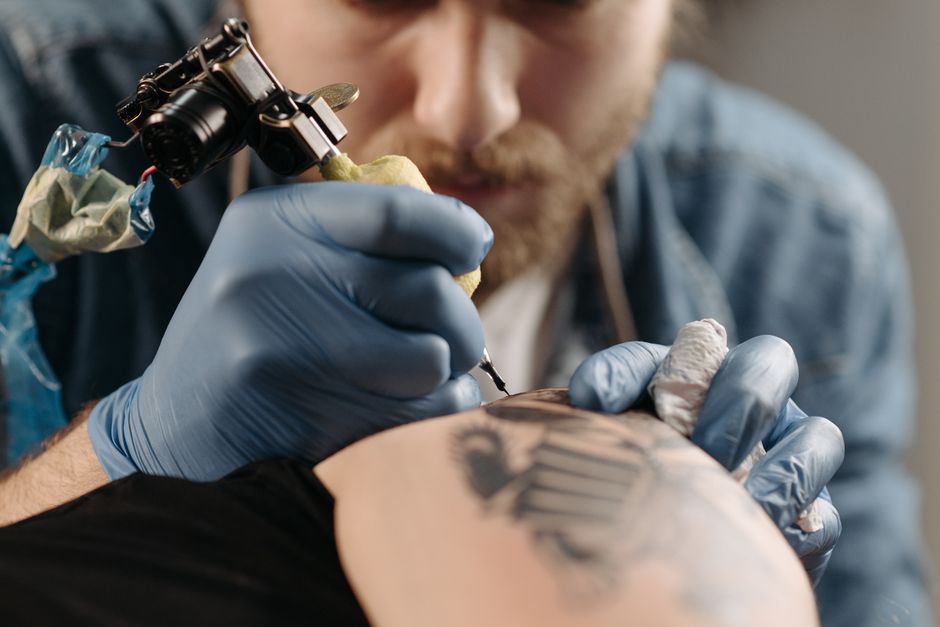
A tattoo needle passes through the epidermis (the outer layer) and deposits ink into the dermis, the deeper, more stable layer that does not constantly shed.
Your skin has three main layers, and each plays a role in how a tattoo behaves:
Epidermis: The outermost layer that constantly renews itself. Ink placed here would flake away within weeks.
Dermis: The target zone. This layer holds collagen, blood vessels, and nerve endings, and it stays stable enough to hold pigment permanently.
Hypodermis: The fatty layer beneath. Ink pushed this deep causes blurry, spreading lines known as blowouts.
The dermis sits roughly 1 to 2 millimeters below the surface. That razor-thin margin is what separates crisp, professional line work from muddy, damaged tattoos. Learning to feel that depth is a skill you build over hundreds of repetitions with a Mentor watching closely.
Why does your body treat tattoo ink like an invader?
Your immune system sees tattoo ink as a foreign substance and sends white blood cells called macrophages to engulf the pigment particles, which paradoxically traps the ink in place and makes the tattoo permanent.
Here is the beautiful irony. Your body is trying to remove the ink, but the pigment particles are too large for the macrophages to carry away. So they hold onto them, staying put in the dermis. When those cells eventually die, new ones capture the same pigment. The tattoo stays visible for decades.
This immune response is also why your skin swells, reddens, and feels warm right after a session. That is not a sign of damage: it is your body doing exactly what it is designed to do. According to the American Academy of Dermatology tattoo care guidelines, proper aftercare supports this natural healing and reduces the risk of infection.
Good to know: The reason laser tattoo removal works is that it breaks pigment into pieces small enough for those same macrophages to finally clear away.
How does a tattoo session unfold, step by step?
A professional tattoo session follows a clear sequence: consultation, skin prep and sanitation, stencil application, outlining, shading and color, then cleanup and aftercare instruction.
Understanding this flow helps you see why every step protects your skin. Here is how a well-run session moves from start to finish:
Consultation: The Tattoo Artist reviews the design, placement, and your skin type before touching a machine.
Sanitation and setup: Gloves, single-use needles, and barrier film go down. This follows OSHA bloodborne pathogen standards that every licensed artist must know cold.
Skin prep: The area is cleaned, shaved, and disinfected to remove bacteria from the surface.
Stencil application: The design is transferred onto your skin as a guide.
Outlining: The artist lays crisp lines into the dermis at a consistent depth.
Shading and color: Layers of pigment build dimension while the artist watches for overworking the skin.
Cleanup and aftercare: The skin is cleaned, wrapped, and you leave with clear healing instructions.
Each of these steps carries real consequences for your skin. Skip sanitation, and you invite infection. Rush the outline and the lines blow out. This is why real training beats watching videos, and why avoiding the common mistakes aspiring tattoo apprentices should avoid starts with respecting the skin.
How does your skin heal after a tattoo session?
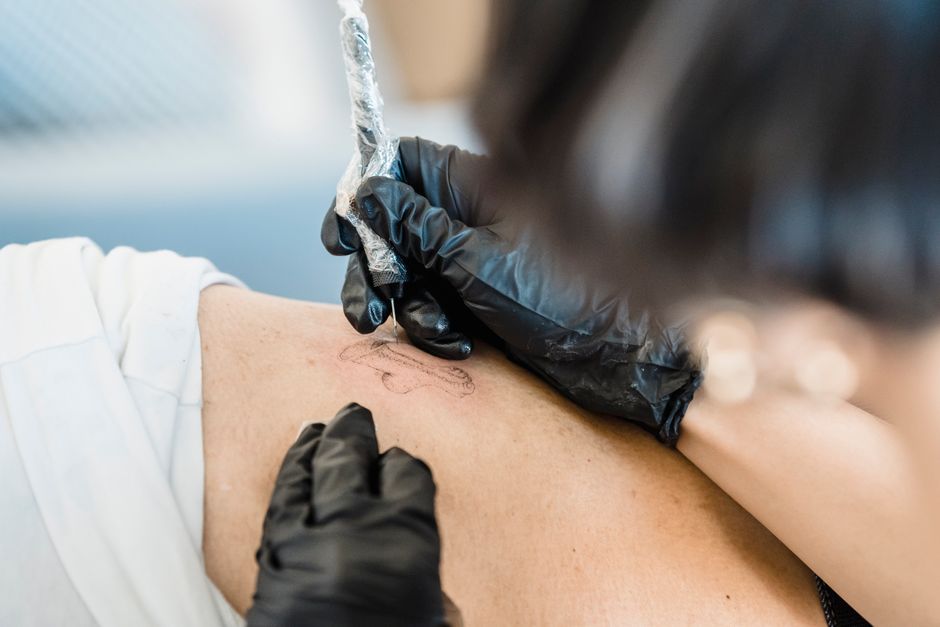
Your skin's surface typically heals in 2 to 3 weeks, forming a light scab and peeling as new skin grows, while the deeper dermis can take up to several months to fully settle the ink.
Right after the session, the tattooed area acts like an open wound. Your body floods it with plasma and white blood cells, which is why a bit of oozing and swelling is normal in the first day or two. As the days pass, a thin protective layer forms and the skin begins to itch and flake.
The mistake many people make is picking at that flaking skin, which can pull pigment out and leave patchy results. Following aftercare guidelines from the American Academy of Dermatology keeps the ink where it belongs. The tools and products used in this stage matter too, which is why knowing the tools every beginner tattoo artist should know is part of doing the craft right.
True healing happens in stages, much like a plant putting down roots you cannot see. The surface looks finished long before the dermis has fully accepted the pigment beneath.
Why does understanding the skin matter for a Tattoo Artist?
Understanding skin anatomy is the foundation of every safe, clean, long-lasting tattoo, and it is a skill artificial intelligence cannot replicate because it requires reading a living, unique human body in real time.
Every client's skin is different. Age, hydration, scar tissue, and body location all change how ink settles. A great Tattoo Artist adapts on the spot, feeling resistance, adjusting angle, and protecting the client's skin from over-trauma. That intuition is built through repetition under a live Mentor, not memorized from a screen.
This is also why tattooing remains a genuinely human, hands-on career. As we explore in our piece on why tattoo artists are still essential, machines can print patterns, but they cannot read the fear in a first-timer's eyes or feel how a specific patch of skin responds. The Bureau of Labor Statistics on craft and fine artists continues to recognize craft and fine artists as skilled professionals whose hands-on expertise carries real value.
If you have been sitting in an unfulfilling job watching your creative potential go to waste, this is the kind of work that fills that gap. It is meaningful, technical, and undeniably human.
How can you learn this the right way with Ink Different?
Ink Different Tattoos teaches skin science and technique through a structured Traditional Tattoo Apprenticeship that pairs you with live, award-winning Mentors and prepares you for licensing and a real professional career.
For over 15 years, since 2011, we have trained aspiring Tattoo Artists to move from zero experience to job-ready professionals. We are a college alternative built for people who want to work with their hands and build an AI-proof career. Explore why tattoo apprenticeships are gaining ground as a college alternative.
What you can expect from our Traditional Tattoo Apprenticeship
Our Traditional Tattoo Apprenticeship runs 18 to 24 months across four phases. You start remotely to build your foundation, then finish in real Tattoo Studios with hands-on training. No prior art experience is required. We meet you where you are and grow your skills from the roots up.
Phase-based structure: Foundations, skin practice, supervised client work, and independent readiness.
Live, in-person mentorship: Real Mentors reading real skin alongside you, not pre-recorded lessons.
Licensing support: Guidance through state requirements so you leave job-ready with the credentials you need.
A career that comes with confidence
You will finish with job-ready skills, licensing support, and the confidence that comes from touching real skin under expert eyes. Every state has its own path, whether that is learning how to get your tattoo license in Texas or how long a tattoo license takes in Colorado. We help you navigate it.
Mentorship that pushes your brand and skills further
For those ready to specialize, our one-year in-person Master Mentorship connects you with celebrity and award-winning Mentors like Al Fliction, Liz Cook, Kyle Dunbar, Boneface, and Jordi Pla. It is built for both beginners and experienced artists chasing a specific style, a career explosion, or studio ownership.
Making tattoo training accessible for everyone
We offer Spanish-speaking locations in Denver, Orange County, New York City, Miami, San Antonio, and San Diego, so language never stands between you and this craft. Wherever you are, there may be a path near you.
Our "Good Humans" culture means you are never doing this alone. You join a supportive, family-like community of people who chose the same brave path you are considering.
Ready to become a Tattoo Artist?
You now understand what your skin goes through: the layers, the immune response, the healing, and the human skill it takes to do it right. Seats in our hands-on training are limited by design, because real mentorship cannot be mass-produced.
Ready to become a Tattoo Artist? Apply now to Ink Different's Traditional Tattoo Apprenticeship and start building an AI-proof career with licensing support along the way. You can also fill out our quick questionnaire to get personalized support and find out if our Tattoo Apprenticeship Program is right for you.
Frequently Asked Questions
How deep does a tattoo needle go into the skin?
A tattoo needle deposits ink into the dermis, roughly 1 to 2 millimeters below the surface. Too shallow and the ink fades; too deep and it causes blowouts and scarring.
Why does a tattoo stay permanent?
Your immune system sends macrophages to engulf the ink, but the pigment particles are too large to remove. They stay trapped in the dermis, keeping the tattoo visible for decades.
How long does it take skin to heal after a tattoo?
The skin's surface usually heals in 2 to 3 weeks, while the deeper dermis can take several months to fully settle the ink. Proper aftercare protects the final result.
Do I need art experience to learn how skin and tattooing work?
No. Ink Different's Traditional Tattoo Apprenticeship is built for beginners and teaches skin anatomy, sanitation, and technique from day one with live, in-person Mentors.
How long is Ink Different's Traditional Tattoo Apprenticeship?
Our Traditional Tattoo Apprenticeship runs 18 to 24 months across four phases. You start remotely to build your foundation, then finish hands-on in real Tattoo Studios.
What makes tattooing an AI-proof career?
Tattooing requires reading a living, unique human body in real time, adjusting to skin type, and building client trust. That hands-on human judgment is something machines cannot replicate.