Why the Outline Stage of a Tattoo Hurts More Than the Shading for Most People
You know that flinch. The client takes a breath, the machine buzzes to life, and the first line goes down. Their knuckles go white, their jaw sets, and you can almost hear them thinking, "It's going to be like this the whole time?" Then something surprising happens. When you switch to shading, they relax.
The war is over before it started. If you have ever wondered why that first outline feels so much sharper than the fill, you are not imagining it. Tattoo outline pain is the more intense, concentrated discomfort people feel when a Tattoo Artist traces the crisp, defined lines of a design, caused by a tighter needle grouping cutting a single deliberate path through the skin.
Understanding that difference is one of the first signs you think like a real Tattoo Artist, and at Ink Different Tattoos, that kind of curiosity is exactly where great careers begin.
Key Takeaways
Why it hurts more: Outlining uses tight needle groupings and steady pressure to create one sharp, concentrated line.
Why shading eases up: Shading spreads pressure over a wider area with softer, sweeping passes, feeling more like scratching.
Location matters: Bony, thin-skinned areas like ribs, ankles, and elbows amplify outline pain the most.
Technique changes everything: A trained artist's hand speed and machine control directly affect how much a client feels.
You can learn this: Ink Different's Traditional Tattoo Apprenticeship teaches pain-aware technique from day one, no experience needed.
Why does the outline stage of a tattoo hurt more than the shading?
The outline stage hurts more because it uses a tight cluster of needles to press a single, deliberate line into the skin, concentrating pressure and nerve stimulation into a narrow path rather than spreading it out.
Think of it like the difference between a pinprick and a firm palm press. The outline is precise and focused, so your body's nerve endings get one clear, sharp signal in a small zone. Shading, by contrast, softens and blends that sensation across a bigger surface.
There is also the element of surprise. The outline comes first, when your client is most tense and their body has not yet released the natural endorphins that dull discomfort over time. By the time you shade, their nervous system has adjusted.
Pro Tip: Tell your client the outline is the sharpest part and it gets easier. Managing expectations is half of managing pain.
What is actually happening to your skin during the outline?
During the outline, a tight needle grouping punctures the epidermis and deposits ink into the dermis along a single continuous path, creating a small, defined wound that your nerves register as sharp, direct pressure.
Your skin has two working layers that matter here: the outer epidermis and the deeper dermis. A quality line needs to reach the dermis so the ink stays put for life. That depth, combined with the concentrated needle path, is what your client's nerves report as intensity.
Because a professional line demands a steady, unbroken pass, there is no break in the sensation. This is also why hygiene and depth control matter so much. Following OSHA bloodborne pathogen standards protects both you and your client during every single pass of that needle.
Why does shading feel different from the outline?
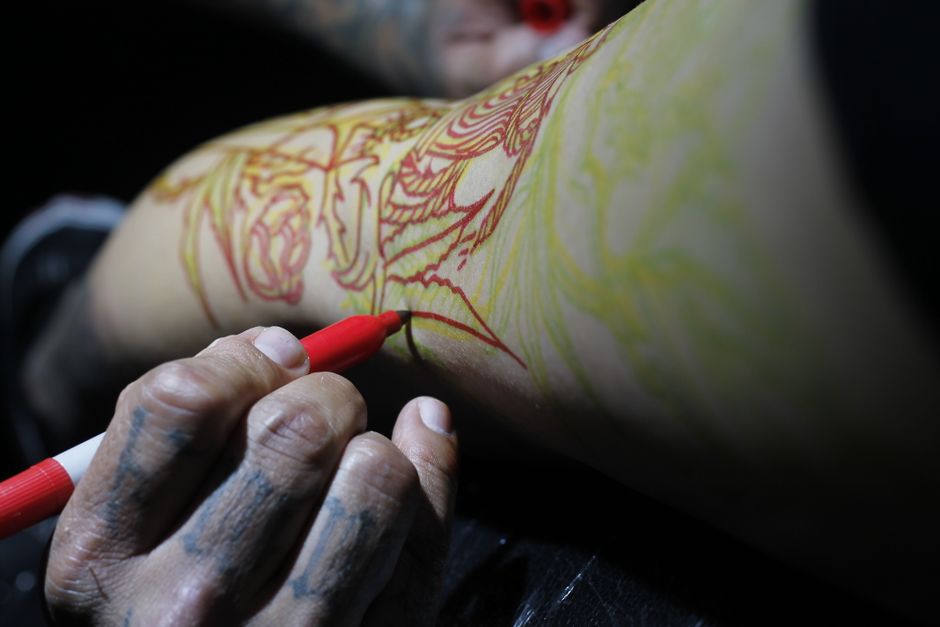
Shading feels gentler because it uses wider needle groupings and lighter, sweeping motions that spread pressure across a broader area, producing a warm, scratchy sensation instead of a sharp cutting one.
When you shade, you are not carving one line. You are gliding across skin in soft, overlapping passes to build tone and depth. The pressure is distributed, and the pace is different, so the nervous system responds less aggressively.
There is a psychological factor too. Your client has already survived the outline. Their body has ramped up endorphins, their breathing has settled, and the fear of the unknown is gone. That mental shift alone lowers perceived pain.
Outline: Tight grouping, steady pressure, one continuous path, sharp sensation.
Shading: Wider grouping, lighter passes, broad coverage, dull or scratchy sensation.
Where on the body does the outline hurt the most?
The outline hurts most on bony, thin-skinned areas like the ribs, ankles, spine, elbows, and inner arms, where nerve endings sit close to the surface and there is little fat or muscle to cushion the needle.
Placement is one of the biggest variables in how a client experiences tattoo outline pain. Fleshy, muscular areas like the outer thigh, calf, or upper arm are far more forgiving. Bone-adjacent zones amplify every pass.
As a Tattoo Artist, knowing this lets you set honest expectations and plan sessions smartly. You might place the toughest outlining work early when your client is fresh, then move to easier zones as fatigue sets in.
Callout: The most painful outline spots for most people include the ribcage, sternum, ankle, inner bicep, and the tops of the hands and feet.
How can you help a client manage outline pain?
You help a client manage outline pain by preparing them mentally, controlling your pace, working in strategic sections, and guiding their breathing, all of which are skills a structured tattoo apprenticeship trains into your hands.
Pain management is not just about the client's mindset. It is a craft you develop. Here is a simple step-by-step approach experienced artists use.
Step 1: Set expectations before you start
Tell your client the outline is the sharpest part and it eases into shading. Naming the experience takes away the fear of the unknown.
Step 2: Start in a forgiving spot when possible
If the design allows, begin in a fleshier area so their body adjusts before you reach the sensitive zones.
Step 3: Control your pace and hand speed
A confident, consistent line minimizes repeated passes over the same spot, which is where extra pain comes from. Skill reduces suffering.
Step 4: Use breaks and breathing cues
Short pauses on long lines and reminders to breathe slowly help your client's nervous system reset without breaking your flow.
Step 5: Talk about aftercare early
Point clients to trusted resources like the American Academy of Dermatology tattoo care guidelines so their healing supports the work you just did.
Why does the artist's technique change the pain level?
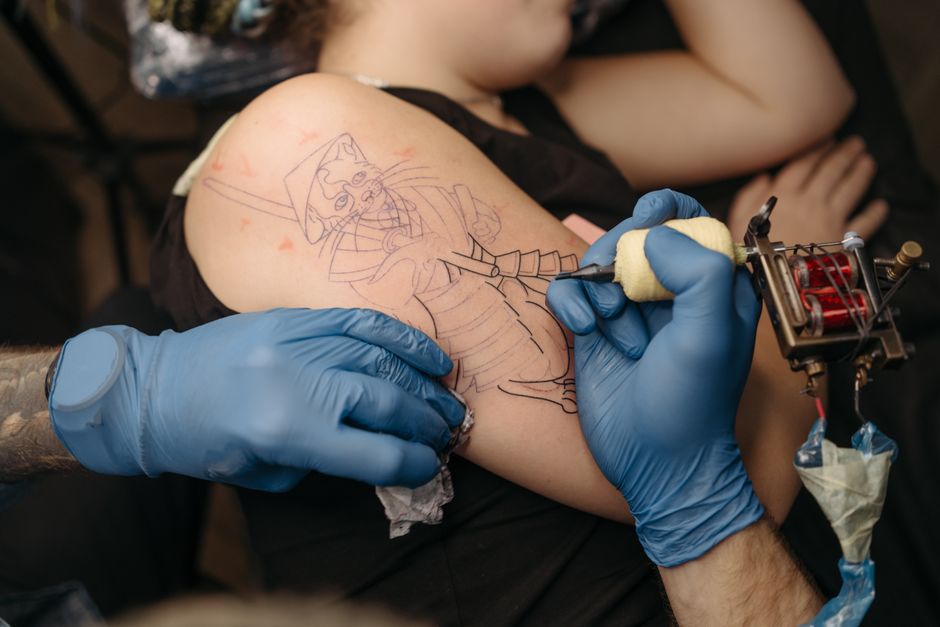
An artist's technique changes the pain level because hand speed, needle depth, machine tuning, and line confidence determine whether the skin gets one clean pass or repeated, traumatic passes over the same area.
Two artists can outline the exact same design and produce wildly different experiences. A hesitant beginner who goes back over lines repeatedly causes more trauma and more pain. A trained artist lays the line once, cleanly, and moves on.
This is why mentorship matters so much. You cannot learn line control from a video alone. You need a Mentor watching your hand, correcting your depth, and helping you develop the muscle memory that protects your clients. If you are just starting out, learning to avoid mistakes aspiring tattoo apprentices should avoid will save you and your clients real pain.
The demand for skilled human hands is not going away. The Bureau of Labor Statistics tracks craft and fine artists as a genuine career path, and tattooing remains one of the few crafts a machine cannot replicate. If you want proof, read why tattoo artists are still essential.
How do you learn to control pain and technique like a pro?
You learn pain-aware technique through live, in-person mentorship in a working Tattoo Studio, where an experienced Mentor guides your hand, machine control, and client care until the skills become second nature.
Here is the honest truth. You can memorize why the outline hurts more than the shading, but knowing it and being able to control it are two different things. The gap between them is closed by hands-on training with real feedback.
This is exactly the pain that stops so many talented people. You feel the pull toward a creative career, you are stuck in a job that drains you, and your potential is going to waste. The seed is there. It just needs the right soil. Now is the moment to plant it, and starting your tattoo apprenticeship is how the growing begins.
What does the Ink Different apprenticeship teach?
Ink Different's Traditional Tattoo Apprenticeship is an 18 to 24 month, four-phase Tattoo Artist training program that teaches beginners everything from line control to pain management to licensing support, with no prior experience required.
For over 15 years, since 2011, we have been training aspiring Tattoo Artists through a proven, hands-on path. We are a college alternative built for people who want a real, AI-proof career instead of a mountain of debt and a degree that may not pay off. Learn more about how tattoo apprenticeships are gaining ground as a solid alternative to college.
What you can expect from our Traditional Tattoo Apprenticeship
Start remote, finish in studios: Build your foundation from anywhere, then move into a real Tattoo Studio.
Personalized hands-on training: A live Mentor watches your line work and corrects the exact habits that cause client pain.
Beginner friendly: No formal art background needed. We teach fundamentals from the first day.
Licensing support and job-ready skills: You finish prepared to work professionally, with guidance on your state's requirements.
A career that comes with confidence is one where you walk into any session knowing your hands can do the work. That confidence is not luck. It is trained. Wondering what gear you will use? Start with the tools every beginner tattoo artist should know. You can also explore platforms to help tattoo artists build their brand as you grow your portfolio and clientele.
Mentorship that pushes your brand and skills further
Our Master Mentorship is a one-year, in-person program where you train alongside celebrity and award-winning Master Mentors including Al Fliction, Liz Cook, Kyle Dunbar, Boneface, and Jordi Pla. It is built for beginners and experienced Tattoo Artists alike who want to master a specific style, explode their career, and step toward tattoo studio ownership.
Making Tattoo Artist Training accessible for everyone
We offer Spanish-speaking locations near Denver, in Orange County, near NYC, in Miami, near San Antonio, and in San Diego, so language is never the wall between you and this career. This is a family-like community built on our Good Humans culture, and you will never grow alone.
Ready to take the first step?
The flinch your future clients feel during that first outline is something you will learn to guide them through with a calm, trained, confident hand. But that only happens if you stop waiting. Seats in a real, Mentor-led tattoo apprenticeship are limited by design, because true one-on-one training cannot be mass-produced.
Ready to become a Tattoo Artist? Apply now to Ink Different's Traditional Tattoo Apprenticeship and start building an AI-proof career with licensing support along the way. You can also fill out our quick questionnaire to get personalized support and find out if our tattoo apprenticeship is right for you.
Frequently Asked Questions
Why does the outline of a tattoo hurt more than the shading?
The outline uses a tight needle grouping to press one concentrated line into the skin, focusing pressure into a narrow path. Shading spreads lighter pressure over a wider area, so it feels gentler.
Does everyone find the outline more painful than the shading?
Most people do, but pain is individual. Placement, skin type, and the artist's technique all affect it. Bony areas like ribs and ankles make the outline especially intense for nearly everyone.
Can a tattoo artist reduce how much the outline hurts?
Yes. Confident line control, steady hand speed, smart placement, breathing cues, and honest expectation-setting all lower perceived pain. These are trained skills you develop through hands-on mentorship.
Do I need art experience to learn tattoo technique at Ink Different?
No. Ink Different's Traditional Tattoo Apprenticeship is built for beginners and teaches fundamentals from day one, including drawing, line work, machine control, and client care.
How long does the Ink Different Traditional Tattoo Apprenticeship take?
The Traditional Tattoo Apprenticeship takes 18 to 24 months across four phases. You start remotely to build your foundation, then finish in a working Tattoo Studio with a live Mentor.
Where can I find a Spanish-speaking tattoo apprenticeship near me?
Ink Different Tattoos offers Spanish-speaking locations near Denver, in Orange County, near NYC, in Miami, near San Antonio, and in San Diego, making Tattoo Artist Training accessible nationwide.